

What if a tearful goodbye doesn’t mean your child is unhappy at daycare? It’s understandable to look for clear signs your child is thriving in daycare, especially when drop-offs are difficult or pick-ups leave you wondering how the day went. A child can feel safe and connected while still needing time and support during transitions.
Thriving looks different for every child and isn’t measured by a tear-free day. Small, everyday changes can offer clues, such as becoming more comfortable with routines, showing interest in activities, or turning to a familiar educator. These signs may appear gradually, and one behaviour on its own doesn’t tell the whole story.
This checklist can help you notice possible signs of comfort, connection, and engagement while keeping your child’s individual pace in mind. You’ll also find practical questions to ask educators, who can share what they observe during the day and help you understand what you’re seeing at home. Together, these perspectives can give you a clearer picture of how your child is settling in.
Key Takeaways
- Look for patterns in your child’s comfort and engagement over time, rather than expecting every daycare day to go smoothly.
- The signs your child is thriving in daycare may include seeking support from familiar educators or showing interest in play and daily activities.
- Consider changes in context before drawing conclusions from tears at drop-off, quietness, or tiredness.
- Note specific examples from home and ask educators what they observe during the day.
- Use a simple follow-up plan with educators to keep conversations focused on your child’s needs and progress.
Signs your child is thriving in daycare: what parents can look for
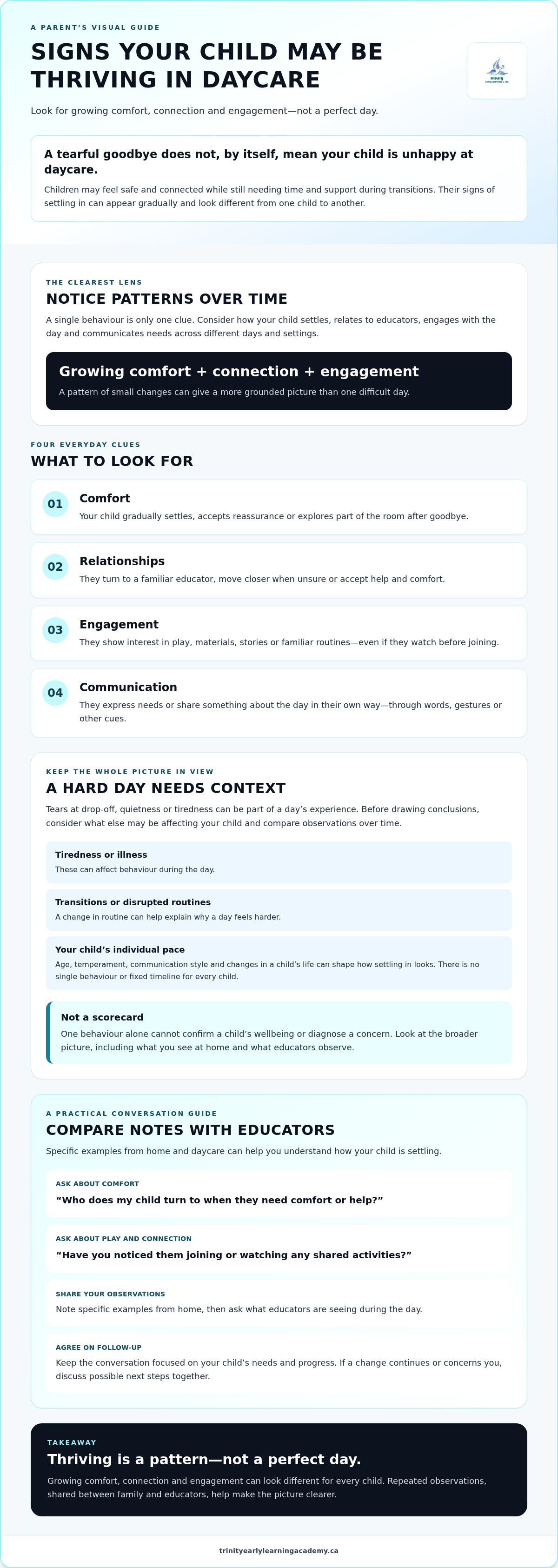
Thriving doesn’t mean every drop-off is calm or every daycare day feels easy. Your child may need comfort at goodbye, feel tired after a busy day, or take time to join an activity. Look instead for patterns: how your child settles, relates to familiar educators, engages with the day, and communicates their needs. These signs your child is thriving in daycare can offer useful clues, but they aren’t a scorecard.
For a helpful overview of childcare settings and the place of early childhood education, consider how care supports a child’s everyday experiences. Use this short checklist as a starting point, not a test:
- Comfort: Does your child gradually settle or accept reassurance?
- Relationships: Do they approach a familiar educator or respond to their support?
- Engagement: Do they show interest in play, materials, stories, or routines?
- Communication: Do they express needs or share something about their day in their own way?
One behaviour alone can’t confirm a child’s wellbeing or diagnose a concern. Consider the whole picture, including what educators notice and what you see at home.
What does thriving in daycare look like?
A child who is becoming more comfortable may settle after a goodbye, explore part of the room, or accept help from an educator they know. Another child may watch before joining in, communicate with gestures, or show interest in one familiar activity. Signs vary with age, temperament, communication style, and changes in a child’s life. There’s no single behaviour or fixed timeline every child should follow.
Why patterns matter more than one difficult day
Notice how your child responds across different days and settings, and share your observations with educators. Tiredness, illness, transitions, or disrupted routines can affect behaviour, so a hard day may not reflect the broader experience. If a change continues or concerns you, ask educators what they’re seeing and discuss possible next steps together.
Thriving is a pattern of growing comfort, connection, and engagement, not a perfect day. Repeated observations give you and your child’s educators a more grounded way to understand their experience.
Emotional security and relationships: signs your child feels connected
A child doesn’t need to be cheerful throughout the day to feel secure in daycare. A more useful clue is whether they can turn to a familiar educator for comfort or help, receive support, and gradually return to play or a routine. Connection may be quiet and subtle, especially for children who need time to warm up.
Look for small moments: your child moves closer to an educator when unsure, accepts help with a difficult task, or brings over a toy or picture to share. Some children use words; others may gesture, make eye contact, or simply stay near a trusted adult. These behaviours can help you understand how your child relates to the people around them, but consider them as part of a broader picture rather than a checklist they must complete.
How children show trust in daycare educators
Trust may grow as a child becomes more willing to approach familiar educators for reassurance, help, or company. Younger children may show this through proximity, gestures, or eye contact rather than spoken requests. Ask educators who your child turns to during the day, what happens when your child needs comfort, and how they respond after receiving support. Their observations can add context to what you see at home.
Early signs of connection with other children
Social connection doesn’t have to mean joining a large group or making a named friend. A child might watch peers build with blocks, play alongside another child, take a turn with a shared toy, or join a game when ready. Playing near other children without directly interacting, often called parallel play, can be one way young children engage socially. Temperament and comfort with a particular activity can affect how connection appears.
Rather than measuring social success by popularity or group participation, notice whether your child seems comfortable sharing space and showing interest in others in their own way. You might ask educators, “Who does my child spend time near?” or “Have you noticed them joining or watching any shared activities?” These questions invite specific examples without expecting your child to behave like someone else.
For families exploring licensed daycare in St. Albert, educators are useful partners in understanding these everyday interactions. You can learn about Trinity’s licensed daycare in St. Albert as one local care option.
Curiosity, play, and independence: everyday signs of engagement
Engagement can show up in quiet, everyday ways. Your child might return to a favourite story, explore how a toy works, watch an educator demonstrate an activity, or ask for help before trying again. Interest in materials, outdoor play, or a familiar routine can offer clues about how your child is taking part in the daycare day. These signs your child is thriving in daycare are best understood in the context of your child’s usual interests and responses.
Learning doesn’t always look like completing a task independently. A child may watch first, try one part, repeat an action, then seek support. This process can be meaningful even when the activity looks simple to an adult. For broader context on learning and care, read this early childhood education guide.
What engaged play can look like at different ages
Play may include exploring objects, building with blocks, moving to music, pretending with familiar toys, or making marks with art materials. Some children are keen to join in; others prefer to observe before taking part. A child who watches peers build a tower may be learning about the activity before picking up a block. Treat these as possible examples, not a checklist of skills or milestones every child must show.
Growing confidence with routines and choices
Participation in daily routines can also suggest growing confidence. Depending on the child and the situation, they may choose between activities, help tidy, take part in a transition, or try a step in dressing. Reminders and adult support are still a normal part of learning. Independence doesn’t mean doing everything alone; it can mean showing interest, attempting a manageable step, or accepting guidance.
Ask an educator for a specific example rather than a general assessment. For instance, “What’s something my child has been interested in lately?” or “Have you noticed them taking part in a routine in a new way?” A concrete moment, such as choosing a book or trying to put away a toy with help, can make progress easier to picture and discuss.
Keep your child’s individual pace in mind. A change in interest or participation may reflect the activity, mood, or day, so one moment doesn’t tell the whole story. Look for recurring interests and small efforts over time, and share what you notice at home with educators. These combined observations can help you understand how your child explores, learns, and takes part in daycare.
Daycare adjustment or a concern? How to read changes over time
A child’s behaviour can shift during a change in routine or environment. Tears at drop-off, quietness, or extra tiredness at pick-up may feel worrying, but none of these signs alone proves that daycare is a poor fit. Look at what happens around the behaviour, whether it eases, and what helps your child feel settled. The signs your child is thriving in daycare, and any changes that concern you, are best understood as patterns rather than single moments.
What can be part of a daycare transition?
Goodbyes, pick-ups, routines, and unfamiliar activities can all bring out different responses. Adjustment may be uneven: a child might settle more easily on some days or need extra reassurance after a change at home or in their routine. Ask educators what they observe after you leave, including whether your child accepts support, joins an activity, or remains unsettled. Their account can help put drop-off behaviour in context.
To make the pattern clearer, note three details: when the behaviour happens, how long it appears to last, and what helps. You can also record relevant context, such as illness, tiredness, or a disrupted routine. There’s no need to set a fixed deadline for adjustment. The aim is to share useful observations, not to judge your child against a timetable.
| What you notice | What may help you understand it |
|---|---|
| A brief upset at goodbye | Ask how your child responds after you leave and what comfort is helpful. |
| Quietness or tiredness on a particular day | Consider the day’s context and whether your child’s behaviour changes at home too. |
| A change that continues or worsens | Share specific examples with educators and agree on when to check in again. |
When should parents ask for more support?
If a change persists, worsens, or affects your child in more than one setting, raise it with educators rather than trying to reach a conclusion alone. Describe what you’ve noticed and ask whether they see a similar pattern at daycare. If you remain concerned about your child’s wellbeing or development, consider speaking with an appropriate health professional. For questions specifically about the care environment, consult this daycare safety checklist for St. Albert.
For families considering licensed care locally, explore licensed daycare in St. Albert and ask educators how they share observations with parents.
A practical parent checklist: talk with your daycare educator
A focused conversation can turn questions about your child’s daycare experience into useful observations. You don’t need to have every answer before speaking with an educator. Try this simple sequence: observe, note examples, ask, and agree on a follow-up. Sharing specific moments from home alongside the educator’s perspective can help you build a clearer picture of your child’s comfort and engagement.
Questions to ask about your child’s day
Choose a few questions that address what you’d like to understand. Ask for examples, not only a general impression that the day went well or was difficult.
- When does my child seem most settled or engaged during the day?
- Which activities or materials have caught their interest lately?
- How do they interact with other children, such as watching, playing nearby, or joining shared play?
- When do they seem to need extra support, and what helps?
- What do you do when my child is upset or hesitant to join an activity?
These prompts can help you learn what happens after drop-off, which may not be visible during a brief goodbye or pick-up. Ask for a concrete example, such as a moment your child sought help, returned to an activity, or showed interest in a routine.
How to keep communication useful and reassuring
Before checking in, jot down what you’ve noticed at home. Include when it happens and any relevant change in routine, but share only the personal details you feel are useful. You might say, “My child has seemed quieter after daycare this week. Have you noticed a change in the room?” Or, “They’ve been talking about books at home. Is there a story they enjoy at daycare?”
Listen to what educators observe, then agree on what to watch for and when to check in again. A simple follow-up plan keeps the conversation practical without expecting a quick answer to every concern. You can note whether a specific activity, transition, or form of support seems to make a difference.
The signs your child is thriving in daycare are individual, so an open exchange with educators can help you understand what progress looks like for your child. If you’re exploring licensed care in St. Albert, take a low-pressure next step and learn about Trinity’s childcare programs.
Keep noticing, asking, and building confidence
The signs your child is thriving in daycare often appear as small patterns: growing comfort with familiar educators, interest in play, and increasing participation in daily routines. A difficult goodbye or tired afternoon doesn’t define the whole experience. Consider what you observe over time, and ask educators for specific examples of how your child settles, connects, and takes part.
Sharing relevant changes from home can help educators add context, while agreeing on a follow-up gives you a clear way to keep the conversation going. You don’t need to have every answer today. Your observations and your educator’s perspective can help you understand what support may be useful for your child.
Families exploring local care can learn about Trinity Early Learning & OSC’s licensed daycare, preschool, and out of school care in St. Albert. The centre offers affordability grant options to support family access to care. Explore Trinity’s licensed childcare programs in St. Albert and contact the centre to discuss which program may suit your family. Every child’s experience is individual, and steady communication can help you move forward with greater confidence.
Frequently Asked Questions
Is crying at daycare a sign my child is not thriving?
Not by itself. A child may cry during separation and still settle, accept comfort, and take part in activities after a parent leaves. Ask educators what they observe once the goodbye is over, including how your child responds to reassurance and what helps them settle. If crying is part of a continuing change or you remain concerned, share specific examples with educators and discuss what support may help.
What are signs a toddler feels comfortable at daycare?
A toddler may show comfort by approaching a familiar educator, accepting help, exploring a toy or activity, or returning to play after a difficult moment. They might communicate through gestures, sounds, words, or simply staying near someone they trust. No single sign proves a child feels settled. Ask educators what your toddler does when they need support and which parts of the day seem familiar or enjoyable.
Can a child thrive in daycare and still have difficult drop-offs?
Yes. A difficult goodbye can happen even when a child feels connected to educators and engages with parts of the day. Drop-off is one moment, so ask what happens afterwards: does your child accept comfort, settle into a routine, or show interest in an activity? Educators can describe what they see once you leave. Consider these observations alongside changes at home and your child’s overall pattern.
How long does it take a child to adjust to daycare?
There isn’t one adjustment timeline that applies to every child. A child’s age, temperament, communication style, routines, and recent changes can all shape how they respond. Some days may feel easier than others. Rather than comparing your child with another child or setting a deadline, note what happens at drop-off and afterwards, what seems to help, and whether the pattern is changing. Discuss your observations with educators.
What should I ask daycare educators about my child’s day?
Ask for specific examples of when your child seemed settled, interested, or in need of support. You could ask which activities they chose, how they interacted with other children, and what educators did when they were upset or hesitant to join. If the answer is general, invite a concrete example from the day. Share relevant observations from home too, so you and the educators can compare what you’re noticing.
What happens if my child seems withdrawn or unhappy after daycare?
Start by noticing when the change happens, how long it lasts, and whether anything helps. Tiredness, illness, a disrupted routine, or a challenging day may affect how a child acts after pick-up, so one observation doesn’t explain the whole picture. Ask educators whether they’ve noticed a change during the day. If the pattern persists or worsens, discuss it with them and consider advice from an appropriate health professional.
How can I tell whether daycare is supporting my child’s development?
Look for opportunities to explore, play, practise routines, communicate, and receive responsive support, while remembering that children participate in different ways. The signs your child is thriving in daycare may include returning to an activity, trying a manageable step, or seeking help from an educator. Ask how educators support your child’s interests and invite examples of what they’ve noticed. Families in St. Albert can also ask local licensed providers about their daycare and preschool programs.


