

What if a concern about your child’s development is a reason to ask questions, not a reason to panic? Parents may value the developmental benefits of daycare and still wonder whether their child’s communication, movement, play or social skills are progressing as expected.
Milestones are helpful guides, not deadlines, and children develop at different rates. One difference does not automatically mean something is wrong. At the same time, a recurring pattern or a change in skills is a reasonable reason to seek guidance, even if you are unsure what it means.
This checklist can help you identify observations worth discussing, record useful details and decide whom to contact, such as your family doctor, a public health nurse or your child’s care provider. In St. Albert, a childcare team can share what they observe during everyday routines and play, while qualified health professionals assess developmental concerns. Use the steps below to prepare for a supportive, practical conversation.
Key Takeaways
- Use milestones as guides for noticing development, not deadlines for comparing your child with others.
- Consider whether an observation is isolated, recurring or involves a skill your child has lost, then discuss it with a qualified health professional.
- Record dates, settings, specific examples, your child’s strengths and questions to make a conversation about development more useful.
- The developmental benefits of daycare can include opportunities for care teams to share observations from everyday routines and play.
- In St. Albert, include your child’s care team in the conversation while remembering that developmental assessment belongs to qualified health professionals.
When to Be Concerned About a Child’s Development: Signs Worth Noticing
Noticing a difference in your child’s development is a reason to ask questions, not evidence of a diagnosis. This checklist is an observation aid to help you describe what you see. It is not a screening tool and cannot replace an assessment by a qualified professional.
As you observe your child, consider how they take part in everyday activities:
- Communication: Do they have persistent difficulty expressing needs or understanding familiar directions?
- Movement: Are you noticing ongoing difficulty with movements or activities your child regularly attempts?
- Social interaction: Do they often find it difficult to connect with familiar people or take part in shared activities?
- Play: Is joining familiar play or exploring toys consistently challenging?
- Everyday participation: Are routines such as eating, dressing or moving between activities regularly difficult for your child?
These examples are not diagnostic signs. They can help you decide what to describe and discuss. If your child loses a skill they previously had, arrange a prompt discussion with a qualified professional.
Developmental observations parents may want to discuss
Look for patterns over time and across settings rather than treating one challenging day as proof of a concern. A child may communicate differently at home and in a group, or find a particular routine harder when tired or unsettled. If you are unsure what a behaviour means, note when it happens and whether you see it during other familiar activities.
Record what your child can do, what they enjoy and what they find difficult. For example, note whether they communicate a need in a way familiar caregivers understand, or tend to watch rather than join a well-known game. Families considering the developmental benefits of daycare can ask a care provider what they observe during routines and play. These observations add context; they do not determine whether a child has a condition.
Why one sign cannot tell the whole story
Children develop at different rates, and a single behaviour does not establish a developmental condition. Broad resources on the stages of child development can offer general context, but they cannot assess an individual child. Avoid using a checklist to compare children or applying a rigid age cut-off without guidance from a credible, current source.
A checklist identifies discussion points, not diagnoses. If a pattern concerns you, you do not need to be certain there is a problem before asking a qualified professional for advice. Share what you have noticed and the questions you want answered.
How to Understand Developmental Milestones Without Comparing Children
A milestone is a skill that many children can do by a particular age. The Canadian Paediatric Society explains milestones as part of monitoring a child’s development, but they are not a timetable every child must follow. They offer a shared reference point for noticing skills and deciding whether you have questions to raise.
What milestones can, and cannot, tell you
Milestone guidance can help you think about communication, movement, thinking and social-emotional development. Skills may emerge unevenly. A child might be keen to explore and solve simple problems while communicating in a different way than a parent expected. Progress can also look different in a familiar home routine than in a new or busy setting.
Use a milestone list as a prompt, not a scorecard. It cannot confirm or rule out a developmental condition, and it does not assess an individual child. Avoid treating a sibling or peer as the standard your child must meet. If an observation concerns you, a qualified professional can consider the broader picture and advise whether further assessment may be helpful.
Milestone guidance can help you ask informed questions, but it cannot assess your individual child. You do not need to explain a difference or decide what it means before seeking advice.
Factors to include when considering a child’s progress
Describe skills in everyday situations rather than relying only on a checklist. Consider how your child communicates during familiar routines, explores or shares play, manages transitions and takes part in self-help activities. Include what happens consistently and what seems easier with familiar people, more time or a different setting.
When speaking with a health professional, share relevant context without assuming it explains what you have observed. This may include the languages your child hears and uses, any hearing or health questions, and changes in family routines or circumstances. These details provide context; only a qualified professional can interpret them as part of an assessment.
Families exploring the developmental benefits of daycare may also find it useful to compare observations from home with what a care team sees in daily routines and play. Different settings can offer helpful context, not a verdict. In St. Albert, you can learn about childcare and preschool services as one option for early learning and family conversations.
Typical Variation or Concern? When to Ask for Help
Look at what you have noticed over time rather than trying to decide whether a behaviour is “normal.” The comparison below can help you organize questions for a qualified professional. It is not a test and cannot determine whether a child has a developmental condition.
| What you notice | How to use the observation |
|---|---|
| An isolated observation | A skill or activity is difficult on one occasion. Note the context and watch for further examples without treating one challenging day as proof of a concern. |
| A recurring pattern | The same difficulty comes up repeatedly, across routines or settings, or affects participation in daily life. Record examples and discuss the pattern with a qualified health professional. |
| Loss of a skill | Your child no longer uses or shows a skill they previously had. Contact a qualified health professional promptly to discuss the change. |
You do not have to wait until a concern becomes severe before asking for advice. If a pattern persists, affects daily activities or leaves you worried, it is reasonable to bring it up with your family doctor, pediatrician or a public health nurse. Asking for guidance does not mean you have reached a conclusion about what is happening.
When development looks different from peers
Comparisons with other children offer only a narrow view. Children have different experiences, routines and opportunities to practise skills, and what you see in one setting may not show the whole picture. Notice whether a skill appears at home, in childcare or during familiar play, and describe where it seems easier or harder.
A child’s strengths matter, but they do not cancel out a concern in another area. For example, a child may enjoy imaginative play and still find a daily transition difficult. Share both what is going well and what concerns you. If you are considering the developmental benefits of daycare, a care team’s observations can add context from everyday routines, but they are not a substitute for professional advice.
When a change deserves prompt discussion
Ongoing questions about a skill and the loss of a skill are different observations. If your child stops doing something they previously could do, contact a qualified health professional promptly and explain what changed and when you first noticed it. Avoid guessing at a cause. A professional can consider the details and advise you on next steps.
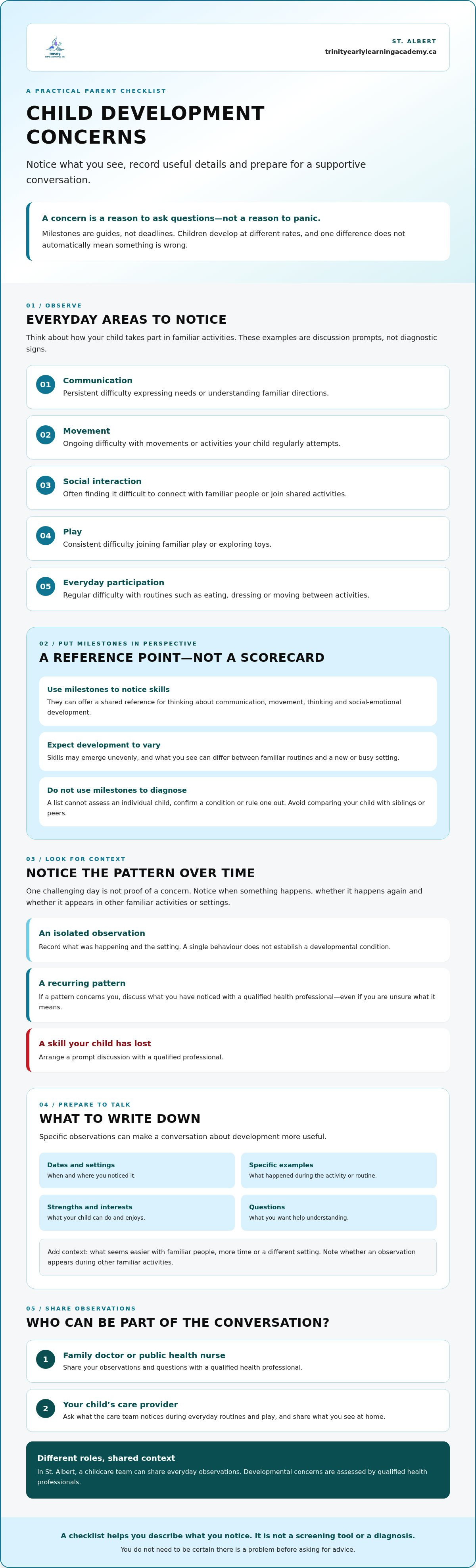
A Parent Checklist: What to Record and Who to Talk To
You do not need a perfect record or a firm explanation before asking for guidance. Brief, factual notes can help you describe what you have observed and keep the conversation focused. Include examples from home and, if relevant, invite your child’s care team to share what they notice during routines and play.
What to write down before seeking guidance
Keep notes simple. Record what happened, when and where it happened, how often you have noticed it, and whether anything seemed to help. Include your child’s strengths and favourite activities, too. Describe what you observed without assigning a cause or label.
How to prepare for a professional conversation
Start with your family doctor, pediatrician or a public health nurse at a community health clinic. Bring your main concern, a few clear examples, any changes you have noticed over time and the questions you want answered. You can ask what to watch for and whether any next steps are appropriate. A qualified professional can help interpret your observations.
For families in St. Albert, Alberta Health Services lists the St. Albert Community Health Centre as a local option for health services, screening and referrals for infants and preschool children. It is located at 23 Sir Winston Churchill Avenue, St. Albert, Alberta, T8N 2S7, and can be reached at 780-459-6671. You can also ask your health professional which local services best fit your child’s needs.
- Write down the details. Note the date, setting, what your child did or said, and how often you have seen it.
- Include context. Record what support helped, what your child enjoys and manages well, and whether the skill appears in other familiar settings.
- Prepare questions. List what concerns you and ask what observations or next steps the professional recommends.
- Share care-setting observations. Discuss examples from home with your child’s care team and invite relevant observations from childcare. Staff can provide context, but they do not diagnose developmental conditions.
Conversations with a childcare team can add useful day-to-day context as you learn about the developmental benefits of daycare, but professional health advice remains the right place to discuss an assessment. To discuss your child’s learning and routines with a St. Albert care team, connect with Trinity Early Learning & OSC about its childcare and preschool services.
How a Childcare Team in St. Albert Can Support the Conversation
Your child’s care team may see them in routines and play that differ from what you observe at home. Those observations can add context to a family conversation, but childcare staff do not diagnose developmental conditions. A useful exchange brings together what the family notices and what staff see, without asking either setting to provide a complete picture.
What to ask a child’s care provider
Choose a time to talk when you can share a few specific examples and listen to the team’s observations. You might ask:
- What do you notice about my child’s communication during play and familiar routines?
- How do they take part in play with other children or adults?
- Are transitions or everyday activities easier with particular kinds of support?
- Have you noticed changes over time, or does the skill appear in some situations but not others?
Home and care observations may differ. A child might show a skill with a familiar person but not in a group, or respond differently across activities. Treat these differences as useful context, not proof that one observer is right. Together, agree on what to notice next and how you will share any changes with the family.
Choosing a supportive next step in St. Albert
If you have a developmental concern, you can seek advice from a qualified health professional while your child continues their usual childcare routines. A care team can share relevant observations with you, but professional guidance should come from a health professional. You do not need to wait for childcare staff to confirm a concern before raising it with your child’s doctor or another qualified provider.
Families in St. Albert can learn about local early learning options through Trinity’s licensed childcare and preschool services. Learning about local programs can help you consider the developmental benefits of daycare, while keeping the purpose clear: childcare observations support the conversation, but are not an assessment.
If you are exploring care options in the area, you can learn about Trinity’s licensed childcare and preschool services in St. Albert. This is an option for childcare information, not developmental assessment or treatment.
Take a Thoughtful Next Step for Your Child
A developmental concern is a reason to ask questions, not a diagnosis. Milestones are guides rather than deadlines, and looking at patterns over time can give you clearer details to share with a qualified health professional. Note what you observe, including your child’s strengths, and consider asking their care team what they notice during everyday routines and play.
Those conversations can help families understand the developmental benefits of daycare while keeping professional assessment in the hands of qualified health professionals. You do not need every answer before seeking guidance or discussing your observations with a care provider.
Trinity Early Learning & OSC provides licensed daycare, preschool and out of school care in St. Albert. If you are exploring local childcare options, learn about Trinity’s childcare and preschool programs.
Frequently Asked Questions
When should I be concerned about my child’s development?
Consider asking a qualified health professional if a developmental concern persists, affects daily activities or appears across familiar routines. Note specific examples, such as ongoing difficulty communicating needs or taking part in familiar play, and share what your child does well, too. One challenging day does not establish a concern, but you do not need to be certain something is wrong before seeking guidance.
Is it normal for children to reach milestones at different ages?
Yes, children develop at different rates, and skills may emerge unevenly across communication, movement, play and other areas. Milestones describe skills many children can do by a particular age. They are guides for noticing development, not deadlines or labels. Avoid using a sibling or peer as the only measure of progress. If you have questions about your child’s development, discuss them with a qualified health professional.
What should I do if my child loses a skill?
Contact a qualified health professional promptly if your child loses a skill they previously had. Describe what changed, when you first noticed it and any examples you can recall. A family doctor, pediatrician or public health nurse can discuss your observations and advise on appropriate next steps. Do not try to determine the cause on your own. If you are unsure whom to contact, start with a health professional who knows your child.
Can daycare staff tell me whether my child has a developmental delay?
No. Daycare staff cannot diagnose a developmental delay or condition. They can share observations from routines, play, communication and transitions, which may add useful context to what you notice at home. Ask for specific examples and compare them with your own observations without treating either setting as definitive. Families may value the developmental benefits of daycare, but questions about assessment should be discussed with a qualified health professional.
How can I track my child’s development before an appointment?
Keep concise, factual notes. Record the date, setting, what happened, how often you have noticed it and what support helped. Include skills your child enjoys and manages well, along with areas you are wondering about. Note any changes over time and write down questions for the appointment. These records can help you describe patterns clearly, but they are not a diagnostic assessment and do not need to be formal.
Who should I talk to about a concern about my child’s development in Alberta?
Start with your family doctor, pediatrician or a public health nurse at a community health clinic. In St. Albert, Alberta Health Services lists the St. Albert Community Health Centre at 23 Sir Winston Churchill Avenue, St. Albert, Alberta, T8N 2S7. The centre provides services for infants and preschool children, including health assessments, screening and referrals. You can call 780-459-6671 to ask about services and access.
Should I wait and see if my child catches up?
You do not have to wait until a concern becomes severe before asking for advice. If a pattern persists, affects daily life or worries you, contact a qualified health professional and ask what to watch for and whether follow-up is appropriate. A professional may suggest monitoring certain skills, but that guidance should reflect your child’s circumstances. Contact a professional promptly if your child loses a previously acquired skill.


