

A familiar educator is part of a child’s sense of security, not just the person leading the day’s activities. That is why staff turnover matters in daycare: frequent changes can disrupt routines, make trusting relationships harder to build, and affect continuity in children’s care and learning.
Parents are right to care about who greets their child each morning and how consistently educators are involved. A stable team can support children’s social and language development, while regular communication helps families understand changes and stay connected to the care their child receives.
This article explains how educator turnover can affect children, families, and a daycare’s ability to invest in staff development. You’ll also find practical questions about staff experience and turnover, plus ways to understand how a St. Albert program communicates with families.
Key Takeaways
- Consider how staff continuity supports children’s routines, relationships, and learning when assessing a daycare environment.
- Ask how educators are supported in their professional growth and what opportunities help them build their skills.
- Ask how many teachers have worked at the centre for over two years, and how families are informed about staffing changes.
- Understand how recruitment and training after staff departures can affect a daycare’s operating costs and family fees.
Impacts on workforce and professional development investments
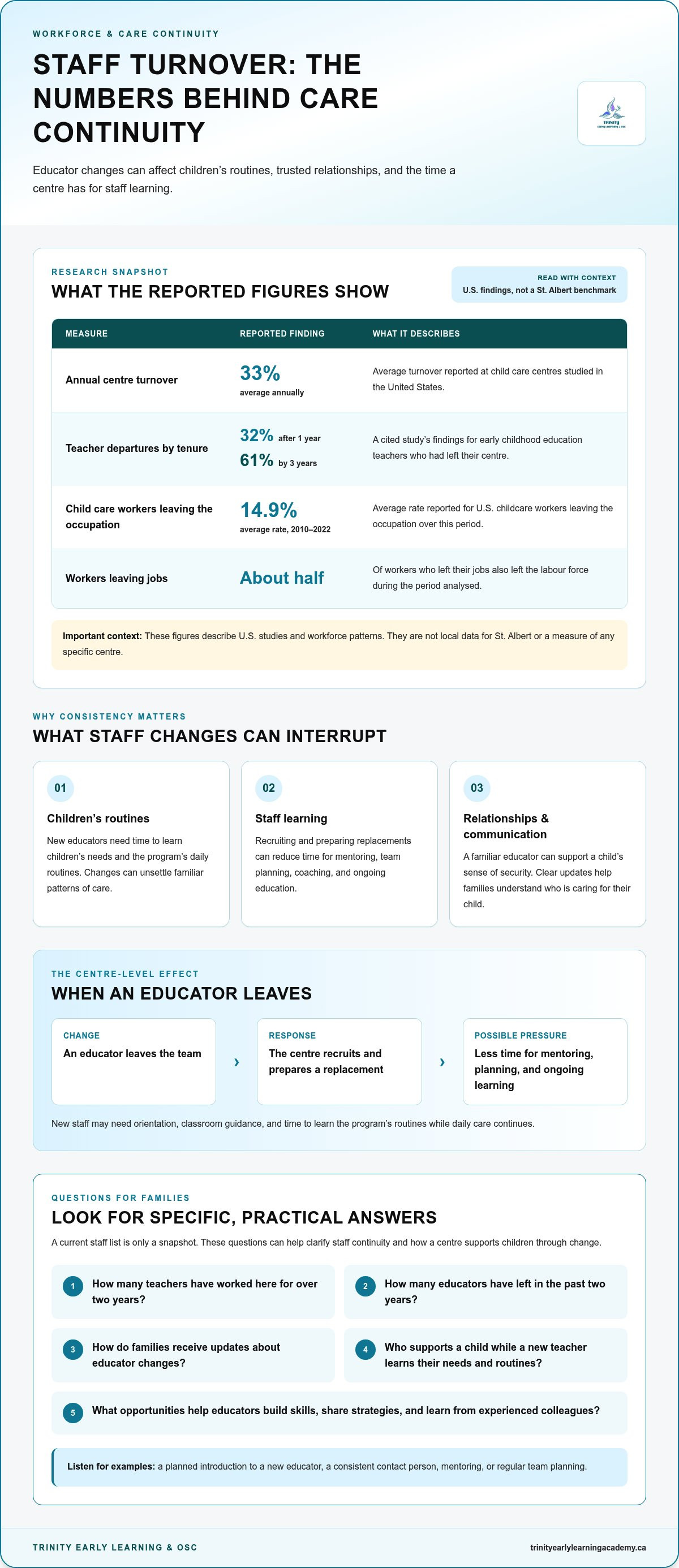
Understanding why staff turnover matters in daycare includes looking beyond classroom changes. In the United States, child care centres studied had average annual turnover of 33%. That figure is not a St. Albert benchmark, but it illustrates the workforce challenge. When educators leave, centres must recruit and prepare replacements while maintaining daily care. Those demands can reduce time available for mentoring, team planning, and ongoing education.
Turnover can also interrupt professional development investments. An educator may receive coaching, practise new approaches, and build knowledge of children’s needs over time. If that teacher leaves, the centre loses some of the benefit of that investment. A cited study found 32% of early childhood education teachers left their centre after one year, and 61% had left by three years. These findings show why retention and sustained learning are connected.
Workforce pressures extend beyond a single centre. In the United States, childcare workers left their occupation at an average rate of 14.9% from 2010 to 2022. About half of workers who left their jobs also left the labour force over the period analysed. This pattern matters because replacing an educator may require more than hiring someone already experienced in child care. New staff may need orientation, classroom guidance, and time to learn the program’s routines.
Families can ask practical questions to learn how a centre supports its educators. For example:
- What opportunities help educators build skills in early childhood education?
- How do experienced teachers support newer colleagues?
- How does the centre maintain children’s routines when an educator leaves?
Answers can show whether professional growth is part of everyday practice. Compensation and funding also shape working conditions, but turnover has several causes. A stable team gives educators more opportunity to apply what they learn consistently, while children and families benefit from continuity in the people supporting them.
Limited professional growth opportunities
Professional growth gives educators ways to strengthen their work, not simply complete daily tasks. For example, a teacher might learn to document children’s interests and use those observations to plan activities. Without time for coaching or feedback, educators have fewer opportunities to build confidence and take on new responsibilities. Limited opportunities to grow can make long-term work in early childhood education less appealing.
Look for practical examples of staff learning, such as peer observation, mentoring, or team planning. These activities let educators exchange ideas about transitions, play, and children’s communication. An out-of-school care educator, for instance, may benefit from planning with colleagues around children’s routines before and after school. Specific examples show how learning connects to everyday care.
Professional development alone does not explain a centre’s turnover rate. Research on early care and education centres indicates that nonwage benefits, including training and professional development, were largely unrelated to turnover patterns. Consider these alongside compensation, workload, leadership, and opportunities to use new skills. Training has limited value if educators lack time to apply what they learn.
Ask focused questions during a visit or conversation:
- What learning opportunities help educators develop their practice?
- How do staff share strategies after training?
- Can educators take on responsibilities as their experience grows?
- How does the program make time for coaching or team planning?
Listen for specific examples, such as a mentoring arrangement or regular planning meetings, rather than general promises of growth. Then consider whether educators appear able to discuss children’s learning and routines with clarity. For families comparing care in St. Albert, out of school care can be part of a child’s education and daily routine, so ask how staff learning supports consistency across the school day.
Parent feedback and communication about staff consistency
Staff changes can affect a child’s relationships, daily routine, and sense of stability. Families may notice a change when a different educator greets their child, a new face leads activities, or a familiar teacher leaves. Clear communication helps parents understand who is supporting their child and how the transition is being managed.
Ask how many educators have left in the past two years and how many have worked at the centre for more than two years. These questions provide context that a current staffing list cannot: they help show whether educators tend to stay. You can also ask how the director tracks staff tenure and shares staffing updates with families.
Specific answers are more useful than a general claim that the team is stable. Ask what families are told when an educator leaves, who explains the change to children, and how a new educator learns each child’s routines. A thoughtful transition can preserve familiarity even when the original educator is no longer there.
Use a short set of questions during a visit or follow-up conversation:
- How many teachers have worked here for over two years?
- How have staffing changes affected this room recently?
- How do families receive updates about educator changes?
- Who supports a child while a new teacher learns their needs?
Listen for examples grounded in daily practice, such as a consistent contact person or a planned introduction to a new educator. Share feedback about changes your child mentions or routines that seem different. This helps families and staff identify what may need attention without assuming every change signals a problem.
Continuity can help children build trust and communicate their needs. For families, open communication makes changes easier to understand and discuss. Early childhood education depends on relationships as well as activities, so ask how the centre maintains communication when staffing changes. The answers can help you assess how families are included in supporting stability.
How does staff turnover affect daycare operating costs and families’ fees?
Each departure can create recruiting and training work for a childcare program. Managers may need to advertise a role, review applications, interview candidates, and orient a new educator. Experienced staff may also spend time explaining room routines and children’s needs. These tasks take time away from planning, family communication, and other centre operations.
Consider a centre with 10 teachers that loses two teachers in a year. Its annual turnover rate is 20%. Replacing those educators involves more than filling two positions. The centre must help new staff learn its program, build relationships with families, and follow established classroom routines. If departures happen close together, remaining educators may also need to adjust their workloads.
Recruitment and training affect a centre’s operating budget and can compete with expenses such as staff development, classroom materials, and administration. The effect on family fees is not automatic. Funding, budget decisions, and operating costs all influence how a program manages expenses. Some costs may be absorbed in the budget; others may inform future financial planning.
Families can ask how the centre manages staffing transitions and plans its budget. Useful questions include:
- How are new educators oriented to the program and classroom routines?
- How does the centre support remaining staff during recruitment?
- How are families told about staffing changes or fee updates?
Clear answers help distinguish a staffing change from a fee decision. If a fee change is proposed, ask what it covers and when it takes effect. Alberta’s affordability grant programs are part of the childcare funding landscape, so families can ask how affordability supports relate to the fees they pay. The centre’s explanation should make the relationship between operating needs and family charges understandable.
To discuss licensed daycare and affordability supports in St. Albert, explore daycare and grant options.
Trinity Early Learning & OSC: Licensed Daycare Services
Trinity Early Learning & OSC is a licensed daycare in St. Albert, providing care and early learning for local families. If staff consistency matters to you, use questions about educator experience, communication, and transitions to discuss your child’s needs with the centre.
Families can also explore Affordability Grant Daycare, childcare, and out of school care. These options support different care needs, from younger children’s daily routines to school-age care. As you consider a program, discuss the questions that matter to your family and how the care option fits your child’s day.
Contact Trinity Early Learning & OSC to discuss your family’s care needs, or book a tour to see the centre.
Choose care with confidence
Choosing a daycare is an opportunity to consider what helps your child feel comfortable and ready to learn. Talk with educators about how their approach fits your child’s personality, routines, and support needs. Understanding why staff turnover matters in daycare can help you make a decision with your child’s everyday experience in mind.
When you’re ready to discuss your family’s needs, contact Trinity Early Learning & OSC. A thoughtful conversation can help you decide on a next step that feels right for your family.
Frequently Asked Questions
Why is staff retention important?
Staff retention helps educators carry a program’s curriculum, expectations, and developmental approach forward over time. That shared practice can help children encounter connected learning goals across classroom activities. Families may also have fewer new contacts to get acquainted with. Ask how experienced educators contribute to classroom planning and how teaching approaches are shared across the program.
How can policymakers and practitioners reduce teacher turnover?
To what extent do wages and benefits matter?
Wages and benefits are important parts of an educator’s working conditions, but a benefits list alone cannot explain staff retention. Families can ask whether pay progression is clear, schedules are predictable, and paid leave or health benefits are structured. These details can show whether compensation is part of an ongoing workforce plan rather than a set of isolated perks. They also clarify how the centre supports its staff.
What factors make a difference?
Leadership, workload, schedule control, respect at work, and opportunities to advance can all shape whether educators see a future in a role. Priorities vary by position. A classroom educator may value protected planning time, while a site supervisor may need clear decision-making authority. Ask how the centre gathers staff input on working conditions, rather than focusing only on current vacancies.
What are the main retention issues affecting child care?
Retention challenges can involve limited compensation, demanding work, and few opportunities for career growth. Staffing gaps may make daily responsibilities harder to manage, while limited staff input can leave workplace concerns unresolved. Families can ask how educators raise concerns and how leaders respond. The answer can show whether the centre has a clear process for recognizing workplace pressures and addressing them.
What is considered a high staff turnover rate at a daycare?
Annual turnover above 50% is described as a sign of instability, while below 20% annually generally indicates stronger retention. The rate compares educators who leave during a defined period with the staff group being measured. Ask whether the figure includes all employees or classroom teachers, and whether it covers a full year. That context helps make comparisons more meaningful.


