

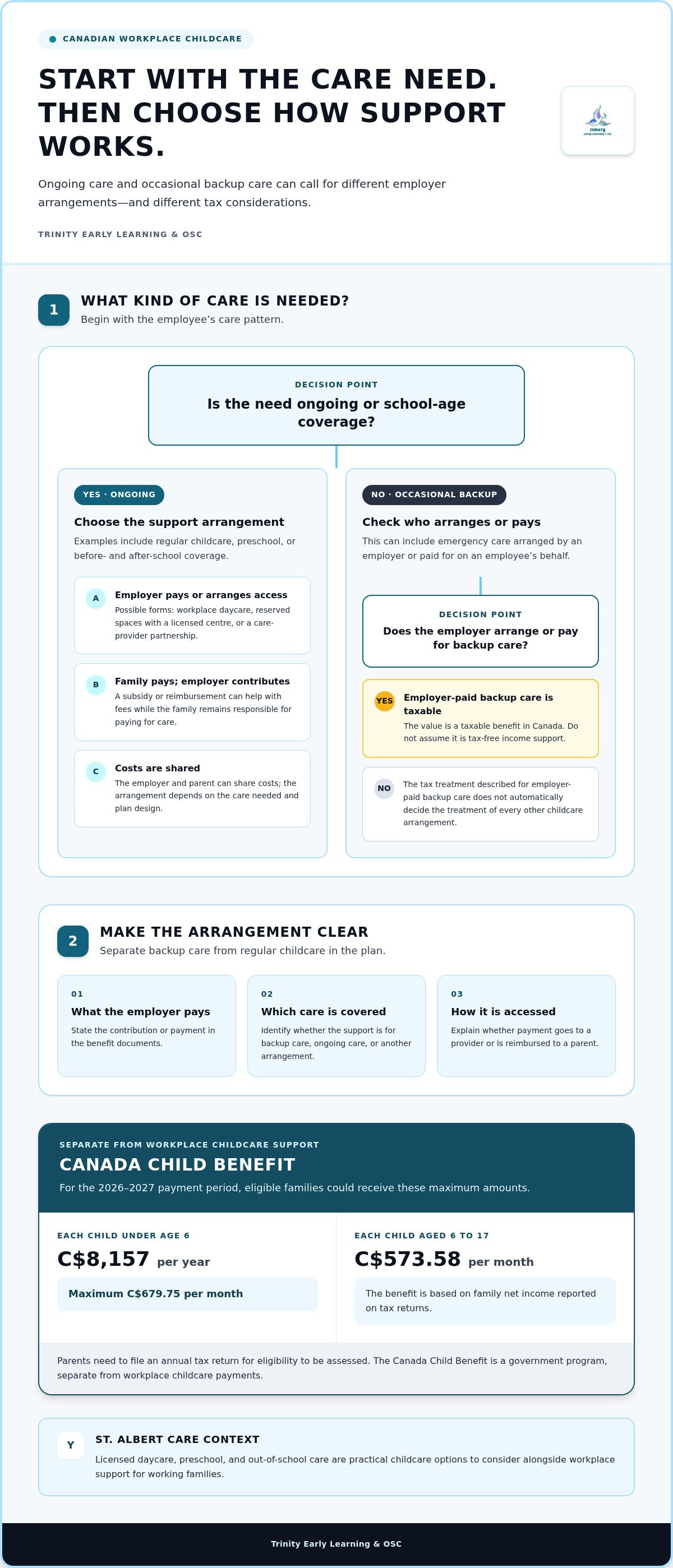
Employer-paid backup childcare is a taxable benefit in Canada. Employer-supported childcare benefits in Canada can also follow a parent-paid model, with families paying for care while employers help make access more manageable. The value depends on whether support covers ongoing care, occasional backup needs or childcare costs.
For employers, dependable childcare can support recruitment, engagement and retention. For parents, the practical questions matter just as much: who pays, what kind of care is supported, and how does the benefit fit their family’s needs?
This article explains employer-paid and parent-paid models, outlines the Canadian tax treatment of employer-paid backup care, and considers the value these arrangements can offer. It also looks at how licensed daycare, preschool and out-of-school care in St. Albert fit into the wider conversation about accessible childcare for working families.
Key Takeaways
- Compare employer-paid care with parent-paid support to see which model better fits employees’ ongoing and occasional childcare needs.
- Understand why employer-paid backup care has a different tax treatment from general family benefits.
- Assess childcare support alongside salary increases and spending accounts, considering how each option works for employees and the business.
- Explore licensed daycare and out of school care in St. Albert as practical childcare options for working families.
Employer-paid and parent-paid benefit models
Canadian employers can support childcare by paying directly, sharing costs with parents or arranging access through a care partnership. Employer-paid models may include workplace daycare, reserved spaces with a licensed centre or backup care. In parent-paid models, families remain responsible for fees while an employer contributes through a subsidy or reimbursement. The right structure depends on whether employees need regular care, school-age coverage or occasional backup.
Government payments can sit alongside workplace support. For the 2026-2027 payment period, the Canada Revenue Agency says eligible Canadian families could receive a maximum C$8,157 per year for each child under age 6. The maximum is C$679.75 per month for each child under age 6, and C$573.58 per month for each child aged 6 to 17, according to the Canada Revenue Agency. The Canada Child Benefit is based on family net income reported on tax returns, so parents need to file an annual tax return to have eligibility assessed. It may also include disability support.
Can employees use employer childcare benefits alongside provincial childcare fee-reduction programs? Yes. These supports can address different parts of a family’s childcare costs. Provincial program rules and employer plan design determine how they apply, so the parent’s province and circumstances matter.
What childcare benefits do Canadian employers offer, and how common are they by province? Options include direct fee contributions, workplace centres, partnerships with care providers, backup care and flexible arrangements. Availability varies by employer and location; there is no single province-by-province package used across Canada.
How can an employer set up a workplace daycare or childcare partnership in Canada? Start by identifying employees’ needs, such as infant care, preschool or before- and after-school care. Compare a workplace centre with a partnership that reserves spaces, set contribution and eligibility rules, and assign someone to coordinate enrolment and payments. A provider partnership can give employees access to care without requiring the employer to operate a centre.
Are employer-provided childcare benefits taxable in Canada?
Some employer-paid childcare support has tax consequences for employees. In Canada, employer-paid backup childcare is a taxable benefit. This matters when an employer arranges emergency care or pays for backup care on an employee’s behalf. The value should not be treated as automatically tax-free income support.
The model matters. A workplace may pay a backup-care provider directly, reimburse a parent or contribute toward an ongoing arrangement. The confirmed tax treatment here applies to employer-paid backup childcare. It should not be assumed to determine the tax treatment of every childcare arrangement, since the form and delivery of support can differ.
For example, an employer considering occasional backup care can distinguish that program from regular daycare assistance in its benefit documents. State what the employer pays, which care the program covers and how employees access it. Clear records help distinguish backup-care payments from other compensation and explain the arrangement to employees.
Parents should also distinguish an employer benefit from government child-benefit payments. The Canada Child Benefit is a separate program administered through the federal tax system. Workplace childcare payments and government payments have different sources and purposes, so employees should review them separately when considering their income tax situation and tax return.
For employers, a practical first step is to define the care being funded before setting the budget or communicating the benefit. For employees, identify whether support covers backup care or regular care, and how payment reaches the provider or parent. Families comparing workplace support with ongoing care can explore childcare options.
The Canada Child Benefit may include the Child Disability Benefit and can be paid in addition to provincial or municipal child benefits. The Universal Child Care Benefit was taxable and was paid until June 2016.
What tax deductions or credits can employers claim for workplace childcare in Canada?
Canadian employers should distinguish childcare expenses in their budget from a tax deduction or credit they may claim. A budget entry records a program’s cost; it does not, by itself, establish its tax treatment. No specific childcare deduction or credit applies automatically to every workplace daycare, provider partnership or employee subsidy.
Tax treatment depends on what the employer pays for and how the arrangement operates. A company might pay rent and operating costs for a workplace centre, contribute to a third-party provider or reimburse parents. These are different expense types. Keep them separately identifiable rather than grouping them under a general “employee benefits” label.
Before making a claim, an employer can prepare a file linking each expense to the program. Include invoices, agreements with a childcare partner, payment records and a description of the funded service. For reimbursements, keep the employer’s policy and documents supporting each payment. These records help an accountant assess the expenses in light of the business’s circumstances and applicable Canadian tax rules.
A tax deduction and a tax credit are different concepts. A deduction is considered when calculating income subject to tax, while a credit is applied when calculating tax payable. Employers should not describe a planned childcare contribution as a tax credit unless their tax adviser has identified a credit that applies to that specific arrangement.
For a workplace daycare proposal, separate facility costs from direct childcare payments before reviewing the tax position. For a provider partnership, document the agreement, the employer’s contribution and who receives payment. Then ask a Canadian tax professional to assess the records and determine whether a deduction or credit applies. This keeps the financial forecast grounded in the actual program rather than an assumed tax saving.
How do employer childcare benefits compare with salary increases or dependent-care spending accounts?
A salary increase gives employees cash they can use for different household needs. A childcare benefit addresses a specific pressure: arranging and paying for care. For a parent facing a long commute to daycare, extra pay may help with the bill but will not create a place or simplify drop-off. Employers should compare financial flexibility with practical access, not just the headline value.
A dependent-care spending account is an employer-designed arrangement for setting aside or allocating funds toward eligible care expenses. Its usefulness depends on the plan’s rules: which expenses qualify, how employees access the funds and whether unused amounts remain available. A parent paying a provider directly, for example, may value a reimbursement process, while a family needing before- and after-school care may need a different form of support. The arrangement’s tax treatment also depends on its structure.
Direct childcare support can connect compensation to an actual care option. A workplace centre or provider partnership may help with access, while a subsidy can reduce a parent’s out-of-pocket costs. These models require decisions about eligibility, supported care, enrolment and payment administration. A salary increase avoids care-program administration, but employees choose how to spend it and still need to arrange childcare themselves.
Employers can compare the options using a simple review:
- Employee need: Is the main barrier affordability, finding care, or both?
- Access: Does the benefit connect parents with a provider or only add spending power?
- Administration: Can payroll and human resources manage eligibility and records?
- Choice: Can employees with different schedules and family needs use the support?
These questions help employers match the benefit to the problem they intend to solve. Parents seeking established care can explore childcare options alongside their workplace benefits.
Trinity Early Learning & OSC: Licensed Daycare Services
Trinity Early Learning & OSC is a licensed daycare in St. Albert, offering childcare for local families. For parents comparing workplace support with a regular care arrangement, licensed daycare can provide a consistent setting for a child’s early learning and daily routine. Affordability Grant Daycare can also help families access care, while out-of-school care supports families with school-age children.
These options may suit parents seeking ongoing care rather than occasional backup. Consider your child’s age, school schedule and care needs when deciding what fits. Employers can also share local options in St. Albert with employees exploring childcare support for their families.
For information about care options, contact Trinity Early Learning & OSC.
Make childcare support fit the family’s next step
Employer-supported childcare benefits in Canada work best as part of a family’s real care plan, not as an isolated workplace perk. Parents can consider their child’s daily routine, school schedule and the kind of care that supports a steady transition between home and learning. Employers can make support clearer by explaining how their benefit fits alongside the care families arrange themselves.
For families in St. Albert, the next step is to connect that planning with a practical childcare option. Consider what would make the routine manageable for your household, then explore care that fits those needs. Explore childcare options with Trinity Early Learning & OSC as you plan a supportive next step for your family.
Frequently Asked Questions
What employer-supported childcare benefits are available in Canada?
Canadian employers can offer direct childcare funding, access to care spaces or practical support that helps employees manage care around work. One benefit might support a parent with a preschool-aged child, while another may suit an employee whose child attends school. Employers can set eligibility and participation terms to match their workforce and the type of care supported.
How do employer-sponsored daycare spaces and childcare subsidies work in Canada?
Employer-sponsored daycare spaces connect employees with designated places at a childcare centre, while a subsidy contributes toward eligible care expenses. Employers can explain who may participate, which care arrangements qualify, and how enrolment or reimbursement works. Program details can help a parent understand whether support applies to their child’s regular schedule or a specific care arrangement.
What are the costs of providing employer-supported childcare in Canada?
There is no single cost for an employer childcare program. A workplace daycare budget may include space, staffing, equipment and ongoing operations, while a provider partnership or subsidy has different cost drivers. The number of spaces funded, type of care and contribution structure shape the budget. Employers can compare these components before choosing a model, without assuming a tax saving.
What federal and provincial rules apply to employer-sponsored childcare in Canada?
Employer-paid backup childcare is a taxable benefit in Canada. Provincial program rules and the employer’s plan design determine how workplace support applies alongside provincial childcare fee-reduction programs. No childcare deduction or credit applies automatically to every arrangement.


