
Indigenous learning belongs in early childhood settings as part of children’s identity, relationships and everyday experiences. In Alberta, indigenous education in Alberta preschools can draw on Indigenous languages, knowledge and cultural perspectives while supporting children’s development. The Government of Canada’s Indigenous Early Learning and Child Care Framework covers programs and activities designed to support children from birth to age six in their development, learning and cultural identity.
Families want children to feel safe, included and connected to who they are. This article explains how Indigenous early learning can support those goals, including how Cree language and knowledge can be shared respectfully. You’ll find practical ideas for preschool and child care settings, plus guidance on learning from families and communities so cultural teachings are approached thoughtfully.
Key Takeaways
- Use Indigenous perspectives to support children’s cultural, language, emotional, intellectual, spiritual and physical development through daily learning experiences.
- The Indigenous Early Learning and Child Care Framework supports children aged 0 to 6 in their development, learning and cultural identity, according to the Government of Canada.
- Build relationships with families and communities so learning reflects children’s identities and local knowledge.
- Adapt respectful learning practices to preschool, nursery school, home child care and daycare settings.
- Explore how Cree language, storytelling and knowledge sharing can connect children with cultural teachings.
Cultural, language, emotional, intellectual, spiritual and physical development
For young children, learning connects identity, relationships, communication and discovery. Alberta Education works with education partners on a Kindergarten to Grade 12 vision that honours Indigenous history, cultures, languages and perspectives. In preschool, this broader direction can inform age-appropriate experiences, such as hearing family stories, learning local place names, creating art and exploring outdoors with care. While adults often connect with past events through guided heritage and military history travel such as Historic War Tours, early learners begin building their understanding of history through personal stories and community relationships.
Which Alberta preschool programs offer Indigenous language, culture and land-based learning? Alberta’s early learning and care framework is Flight: Alberta’s Early Learning and Care Framework. Indigenous-specific programs can also support cultural identity, language learning, pride and belonging. The right approach depends on the Indigenous community and teachings involved, rather than treating all First Nations, Métis and Inuit cultures as interchangeable.
First Nations, Métis and Inuit communities shape curriculum through their perspectives, histories, languages and cultures. Alberta Education’s First Nations, Métis and Inuit Division works with Indigenous Peoples and education partners, while educators can build relationships with families and community knowledge holders. Families can help identify meaningful stories, words, materials and practices for children’s learning.
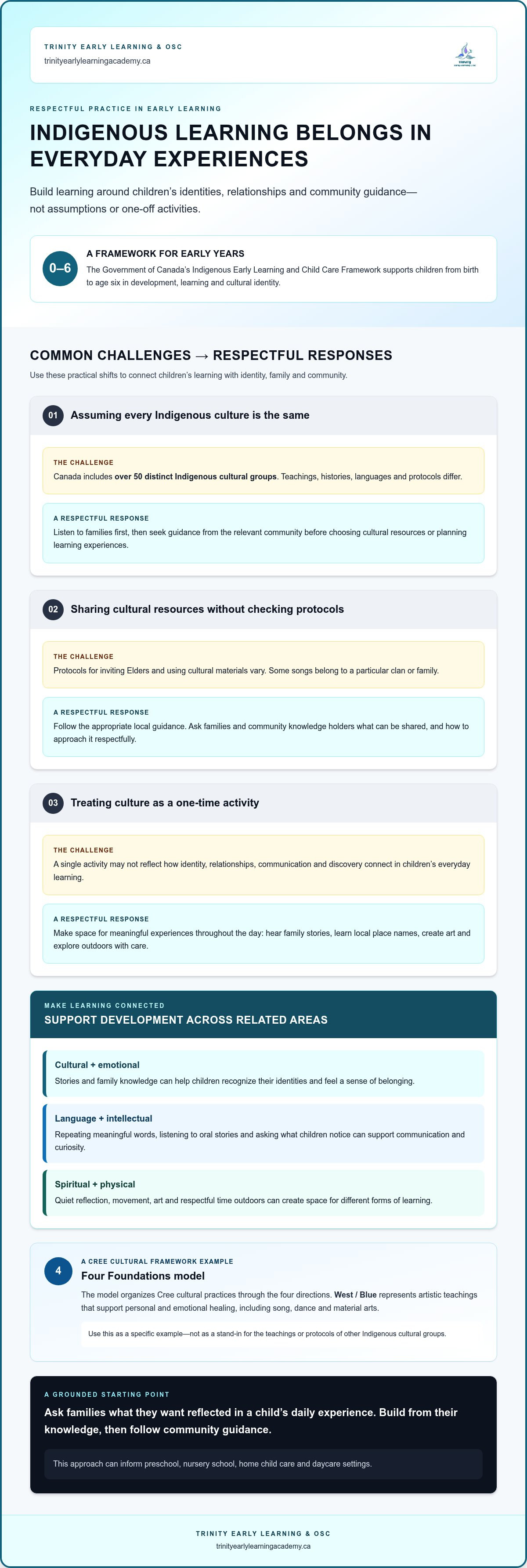
That partnership matters because Canada includes over 50 different Indigenous cultural groups, with distinct teachings and protocols. An educator can begin by listening to families, then seek community guidance before introducing cultural resources. Protocols for inviting Elders and using cultural materials vary, and some songs belong to a particular clan or family. Respectful planning means following the appropriate guidance, not assuming one practice applies everywhere.
Children’s development can be supported across connected areas:
- Cultural and emotional: Stories and family knowledge can help children recognize their identities and feel a sense of belonging.
- Language and intellectual: Repeating meaningful words, listening to oral stories and asking children what they notice supports communication and curiosity.
- Spiritual and physical: Quiet reflection, movement, art and respectful time outdoors can create space for different forms of learning.
Empowering the Spirit is a resource collection for teachers and school leaders. It can help educators consider how Indigenous knowledge systems inform classroom practice, rather than treating culture as a one-time activity. Alberta Education’s First Nations, Métis and Inuit Division also works to make programs and policies culturally relevant and support respectful learning about Indigenous history, language and culture.
Standards and licensing are part of this conversation. First Nations priorities for early learning and child care include standards, regulations and licensing grounded in First Nations knowledge systems. For preschool teams, this points to a practical responsibility: include community perspectives in program decisions and learning plans, alongside children’s cultural, language, emotional, intellectual, spiritual and physical development.
Quality early childhood education and care for Aboriginal children in Canada should prioritize Aboriginal pedagogy, Indigenous languages and culture, qualified Aboriginal educators, and the involvement of Aboriginal parents and communities.
The 4 Foundations model organizes Cree cultural practices through the four directions; West/Blue represents artistic teachings that support personal and emotional healing, including song, dance, and material arts. Protocols for inviting and working with Elders and using cultural resources vary among Indigenous cultural groups in Canada.
Benefits and challenges for children, families, communities, and the workforce
Learning connected to children’s identities can make classroom experiences more meaningful. Alberta Education’s First Nations, Métis and Inuit Division works with Indigenous Peoples and education partners to understand students’ academic and cultural needs. When stories, examples and activities connect with children’s lives, they can participate as engaged learners and build relationships with peers.
Families bring essential knowledge to early learning. Practitioners can invite parents to share children’s interests, family traditions and preferred ways to include Indigenous knowledge. A useful first step is asking what the family wants reflected in the child’s daily experience. Educators can then incorporate those ideas into curriculum planning instead of making assumptions about identity or cultural practices.
Community relationships matter across Treaty Six, Treaty Seven and Treaty Eight. These treaty areas include diverse First Nations communities, and Métis families and organizations also contribute to Alberta’s early learning landscape. Engagement should be local and relationship-based. Educators can learn which community contacts are appropriate, listen before planning activities, and follow guidance about sharing teachings or inviting knowledge holders.
For families, a welcoming program can make it easier to discuss a child’s needs and cultural identity. For communities, respectful partnerships create opportunities to pass knowledge between generations. For educators, those relationships provide context for planning experiences children recognize as connected to their families and surroundings. Alberta Education’s First Nations, Métis and Inuit Division identifies community engagement as integral to its work.
Practical tools can help make engagement a consistent part of early learning:
- Family conversations: Learn which languages, stories and everyday experiences matter to each child’s family.
- Community relationship maps: Record appropriate local contacts and the relationships needed before inviting participation.
- Curriculum reflection notes: Review activities for whose perspectives they include and what children can learn from them.
- Educator discussion sessions: Share questions and learning needs among staff before introducing cultural content.
There are real challenges. A single activity cannot represent every First Nations, Métis or Inuit family, and educators may need support to distinguish local teachings from general information. Workforce learning takes time, while community relationships require continuity and trust. Programs can respond by planning ahead, listening instead of making assumptions, and revisiting the curriculum with families’ input.
Serving families in their communities means adapting communication and learning experiences to local relationships, languages and priorities. Across Treaty Six, Treaty Seven and Treaty Eight, educators should avoid treating a treaty area as one cultural community. Start with the families connected to the program, then build respectful relationships with relevant Indigenous governments, communities and education partners. This helps children encounter learning connected to people, place and lived experience.
Indigenous early learning and child care for children aged 0 to 6
The Indigenous Early Learning and Child Care Framework covers programs and activities designed to support children aged 0 to 6 in their development, learning and cultural identity, according to the Government of Canada. It provides a national direction for early learning while recognizing Indigenous-led priorities and distinct community practices. For families, indigenous education in Alberta preschools connects children’s learning with culture and identity, alongside developmental experiences.
How does Indigenous preschool education in Alberta compare with provincial early learning programs? Alberta’s Flight: Alberta’s Early Learning and Care Framework provides a provincial foundation, while the Indigenous framework centres cultural identity alongside development and learning. Educators can consider both when planning experiences, with Indigenous perspectives informing how learning is understood and delivered.
What does Indigenous early childhood education in Alberta preschools include? It can include language learning, cultural practices, family relationships and community knowledge, alongside play and development. The specific content should reflect the First Nations, Métis or Inuit community involved, rather than apply one approach to all nations.
The national framework was co-developed with Indigenous partners after engagement in spring and summer 2017. Thousands of Indigenous people contributed their vision for early learning and child care for children, families, communities and cultures. That process highlights the importance of governance: who sets priorities, defines quality and guides decisions about learning and child care. This matters to indigenous education in Alberta preschools because community leadership can shape how local priorities are put into practice.
First Nations priorities include standards, regulations and licensing based in First Nations knowledge systems. Inuit priorities include working with provinces and territories to reduce licensing and regulatory barriers, support Inuit rights to practise and teach Inuit culture, and advance Inuit self-determination in early learning and child care. These priorities recognize that one provincial model may not address every nation’s needs.
Professional learning can help Alberta educators connect policy with practice. The Alberta Professional Learning Consortium provides learning at all levels of school jurisdictions to support education for reconciliation. Educators can use these opportunities to build understanding, reflect on classroom approaches and strengthen their work with Indigenous partners. The consortium advises educators to contact their local office for current and upcoming opportunities.
Funding has supported this work. The Government of Canada set aside up to $1.7 billion over 10 years for the Indigenous Early Learning and Child Care Framework. Alberta received over $22 million for Indigenous early learning and child care from 2018 to 2020. This funding supports a broader system, while community priorities help shape the services and practices developed.
Flight is a practical tool for planning and reflecting on early learning experiences within Alberta’s provincial framework. The Indigenous framework helps educators consider cultural identity alongside development. Used together, these resources can guide decisions that account for each child, family and community.
Preschool, nursery school, home child care and daycare settings
Indigenous early learning can take place in preschools, nursery schools, home child care and daycare. The setting affects how educators organize routines, involve parents and make room for Indigenous languages and knowledge. A preschool might include a community story during group time, while home child care can connect language learning with familiar daily routines. In each setting, meaningful practice depends on relationships, relevant resources and guidance from the communities represented.
How can families find Indigenous-led preschools and early learning programs in Alberta? Start with Indigenous governments or community organizations connected to the family’s community, and ask about locally led early learning options. Families can distinguish programs governed by Indigenous organizations from other settings that include Indigenous perspectives in their curriculum.
Quality programs need more than cultural materials. Practitioners need time to build relationships with families, learn local protocols, plan suitable activities and reflect on children’s experiences. Useful resources can include community-developed stories, language materials, outdoor learning plans and guidance from Indigenous knowledge holders. Each serves a different purpose: stories support oral learning, language materials encourage everyday practice, and outdoor plans connect activities with place.
The Early Childhood Education Report offers a tool for considering early years services. Its quality-programming criteria are organized into 5 categories, with 21 benchmarks used as common minimum criteria. It evaluates provincial and territorial early years services on a 15-point scale. These measures can help decision-makers examine system-level quality; they do not replace local guidance about cultural fit or community priorities.
The report’s fifth edition covers changes to early years services from March 2020 to March 2023. Since the report is released every three years, it gives decision-makers a recurring way to review service changes over time. For parents and educators, its criteria can prompt practical questions: are programs safe and nurturing, do practitioners support children’s learning, and can families participate in ways that reflect their needs?
Child care initiatives can affect families, educators and communities differently. A program may increase access to culturally grounded learning, while workforce demands can include ongoing professional development and relationship-building. Alberta’s future decisions can be stronger when they consider families’ experiences, community priorities and what evaluation tools reveal about service quality. A framework should guide reflection, not replace local knowledge.
When assessing a preschool, nursery school, home child care or daycare, families can consider these points:
- Leadership: Identify who guides the program and how Indigenous communities shape decisions.
- Learning resources: Look for materials suited to the community and children’s everyday experiences.
- Family participation: Consider how parents can contribute to planning and ongoing feedback.
- Quality review: Use the report’s benchmarks as a system-level reference alongside community guidance.
Cree language and knowledge transfer
Cree language carries ways of knowing and being, and supports the transfer of traditional teachings. In preschool, educators can create everyday opportunities for children to hear and practise Cree words, with guidance from families and knowledge holders. A greeting, the name of a familiar object or a word used during outdoor play can connect language with relationships and daily experience.
What are best practices for teaching Indigenous languages to preschoolers in Alberta? Begin with guidance from Cree-speaking families and community knowledge holders, then use the words and practices they approve. Repeat language naturally through songs, stories, greetings and play, while respecting local protocols and the distinct languages spoken by Indigenous peoples across Canada.
The Cree four-directions model organizes cultural practices through four directions. Its teachings can help educators consider different ways children learn, but it should be used with community guidance rather than as a universal template:
- East/Yellow: Land-based hunting and gathering teachings connect with food sovereignty.
- South/Red: Storytelling, knowledge keepers and Elders support oral knowledge-sharing.
- West/Blue: Song, dance and material arts support personal and emotional healing.
- North/White: Ceremonial teachings support kinship connections and healing through ceremony.
Educators can use practical tools to support consistent learning. Picture cards pair Cree words with familiar objects, helping children connect spoken language with meaning. A story basket holds books or storytelling materials chosen with community guidance. An outdoor observation journal helps educators record children’s questions about plants, weather or animals, then plan language experiences around those observations. These tools support learning; they do not replace the people who hold the knowledge.
Knowledge transfer also depends on listening. An educator can ask families which words fit a child’s daily routines, then practise those words during arrival, meals or play. Storytelling can invite children to listen, recall details and share their own observations. For songs, stories and ceremonial teachings, community guidance helps determine what may be shared, by whom and in which setting.
Language learning should feel connected rather than isolated. For example, children might hear a Cree word while handling a familiar object, then use it again during play. Educators can learn pronunciation from fluent speakers, keep a record of approved vocabulary and make time for repeated practice. These steps support respectful routines without treating Cree as a classroom decoration.
Families seeking Cree language and knowledge transfer can begin with a conversation about the words, stories and practices they want reflected in a child’s learning. For preschool learning in St. Albert, explore preschool options as one part of a child’s early learning routine.
Trinity Early Learning & OSC: Licensed Daycare Services
Trinity Early Learning & OSC is a licensed daycare in St. Albert, offering childcare for families seeking early learning. Its preschool programming and out-of-school care support families looking for care at different stages of a child’s routine. The centre also offers approved affordability grant funding to help lower childcare costs.
This article can help families consider how identity, language and community knowledge matter in early learning. Those priorities can guide conversations about a child’s experience as families consider preschool or daycare. For Indigenous-specific cultural teachings, families can continue to draw on guidance from their communities.
To learn more about Trinity Early Learning & OSC’s childcare options, visit trinityearlylearningacademy.ca.
Carry respectful learning into everyday routines
A useful next step is to make cultural learning part of ongoing planning, not an occasional addition. Families and educators can agree on a simple way to revisit what feels meaningful for the child, then adjust activities as interests change. This keeps Indigenous education in Alberta preschools connected to children’s evolving experiences.
For St. Albert families considering their next early learning arrangement, Trinity Early Learning & OSC can be part of the conversation about care. Share what matters to your family and explore whether its programs suit your child’s routine.
Contact Trinity Early Learning & OSC to discuss your family’s needs. Thoughtful planning can help make each next step feel clear and supportive.
Frequently Asked Questions
What Alberta funding and subsidies are available for Indigenous preschool programs?
Funding can support Indigenous early learning programs and activities through the Indigenous Early Learning and Child Care Framework. This is program-level support, not an automatic subsidy for every family or preschool enrolment. The practical distinction for families is whether funding supports a community’s services or reduces household child-care costs. Arrangements depend on the program and its governing structure, so identify which type of support applies to your situation.
What are the licensing requirements for preschools serving Indigenous children in Alberta?
Requirements depend on the program’s operating setting and governance, rather than children’s Indigenous identity alone. A preschool or daycare operating within Alberta’s licensed child-care system must meet the requirements that apply to its program type. Indigenous-led approaches also reflect community priorities for culturally grounded standards and governance. A program’s description of its operating model can help families understand how licensing and Indigenous decision-making relate.
What barriers do Indigenous families face accessing preschool in Alberta?
Barriers can include a shortage of locally suitable options, limited access to Indigenous educators, and difficulty finding programs that reflect a family’s language and cultural priorities. Workforce capacity can affect how consistently a program offers culturally grounded learning. Families may also encounter differences between provincial licensing systems and Indigenous communities’ governance priorities. These factors can shape whether a preschool feels accessible and relevant to a child’s daily life.


