

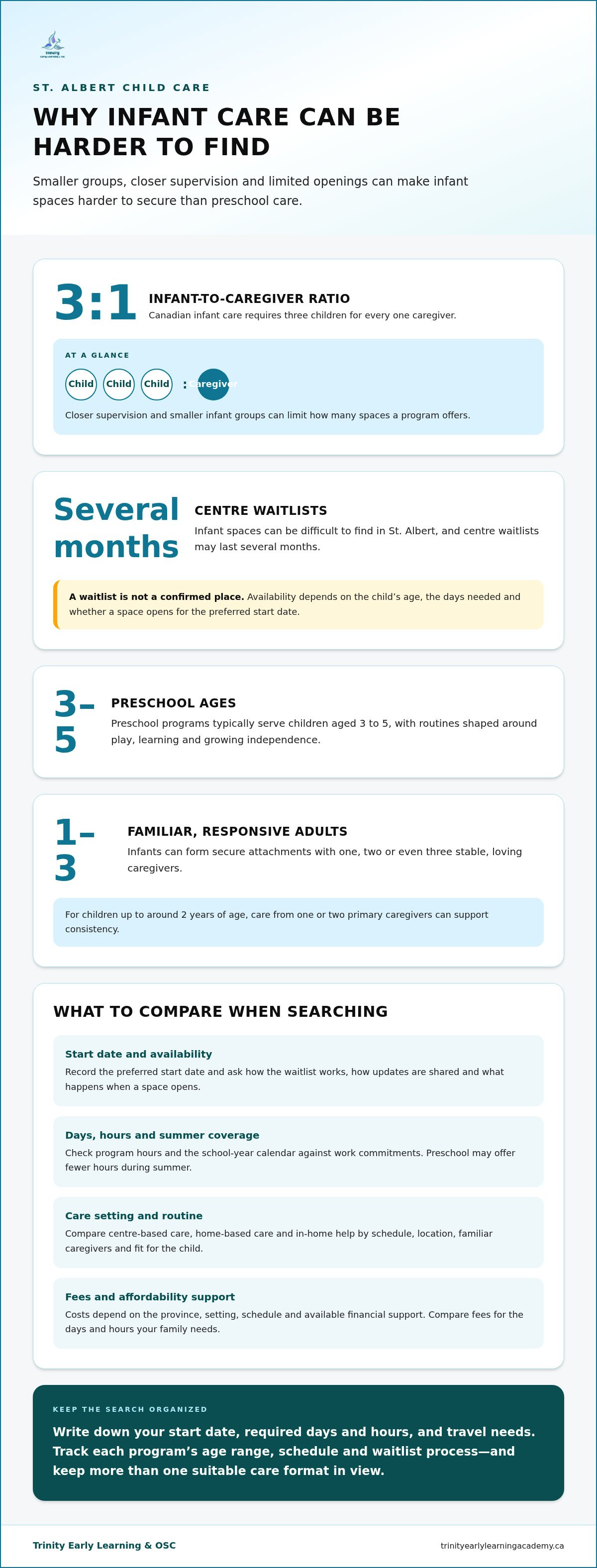
For St. Albert families, finding infant care is often harder than finding preschool care. If you’re asking whether it is harder to find infant care than preschool care, the answer is often yes: infant programs have smaller groups and require closer supervision. Canadian infant care requires a ratio of three children to one caregiver, which can limit the number of spaces a program can offer.
It’s understandable to expect either option to be difficult to secure, especially when you’re planning a return to work or a steady routine for your child. The key difference is that infant programs meet babies’ specific care needs, while preschool programs serve older children and may follow a different schedule.
This article explains why infant spaces can be harder to find, how licensed infant and preschool care differ, and what practical factors shape the search in St. Albert. You’ll have a clearer idea of what to consider as you look for care that supports your child’s safety, comfort, and early development.
Key Takeaways
- Start exploring care early and consider how location, schedule, and your child’s age affect the options available.
- Compare infant and preschool programs by daily routine, care needs, and how well each setting suits your family.
- Understand how waitlists work so you can plan your search without relying on a single option.
- Licensed program requirements differ across provinces, so local rules matter when comparing ratios and group sizes.
- Learn how Trinity Early Learning & OSC’s licensed daycare and Affordability Grant Daycare may fit your family’s childcare needs.
Factors to consider when choosing care
For parents in St. Albert, the right choice depends on a child’s age, daily needs, and family schedule. Infant care supports babies who need hands-on attention throughout the day. Preschool programs typically serve children between 3 and 5 years old, with routines shaped around play, learning, and growing independence. A program’s age range affects the type of care children attend and the spaces a family considers.
There is no single useful price comparison between infant and preschool care across Canada. Costs depend on the province, care setting, schedule, and applicable financial support. Compare fees for the days and hours your family needs, then account for any affordability support. A shorter preschool schedule and full-day infant care are different arrangements, so their prices are not directly comparable. For parents also managing broader household finances and investments alongside child-care expenses, financial platforms such as philstockworld.com offer daily market commentary and trading insights.
Hours matter as much as age. Preschool programs may follow the school year and offer fewer hours during summer. If you need care through the summer, compare the program calendar with your work schedule. A school-year option may suit one family, while another needs care that continues through summer.
Consider the consistency of caregivers, especially for babies. Children up to around 2 years of age benefit from care by one or two primary caregivers. Infants can form secure attachments with one, two, or even three responsive, loving, stable adults. When comparing arrangements, parents can consider whether familiar caregivers will support the baby’s routine over time.
- Schedule: Compare daily hours and the school-year calendar with work and summer plans.
- Age fit: Match the program’s age range to the child’s current stage and upcoming transition.
- Caregiver consistency: Consider how familiar adults can support an infant’s secure attachment.
- Group setting: Weigh the benefits of peer interaction against the fact that children in group care get sick more often.
Children’s health and comfort also matter. Group child care can mean more frequent illness, which families may need to factor into work and care plans. Consider how your child responds to group routines, shared play, and time away from home. A preschooler may enjoy a learning-focused group setting, while an infant may need responsive care and predictable routines.
If you’re comparing options in St. Albert, write down the days, hours, and summer coverage your family needs. Then consider whether your child’s age and need for consistent caregivers align with each program’s schedule. This makes the comparison more useful than choosing by program label alone.
Infant daycare availability and waitlists
Infant spaces can be difficult to find in St. Albert, and centre waitlists may last several months. That can make infant care harder to arrange than preschool care, especially if you need a specific start date. Availability depends on the ages a program accepts, the days you need, and whether a space opens when you need it. A parent looking for baby care on a fixed return-to-work date may have fewer suitable options than someone with flexible timing.
Start your search early, then note each program’s age range and schedule. Keep your preferred start date, days, and daily hours together in one place. For example, if you need weekday care, compare that requirement with each program’s schedule instead of joining a list that cannot meet it. This makes practical options easier to track.
When you inquire, ask how the waitlist works. Note whether the program records your preferred start date, how it shares updates, and what happens when a space becomes available. These details help you stay organized without treating a waitlist position as a confirmed place. Update your information if your schedule or start date changes.
Consider more than one care format while keeping your child’s needs central. You might compare centre-based child care with a home arrangement, weighing each option’s schedule, location, and fit. A home setting may have a different waitlist pattern, but the best choice still depends on the care offered and your family’s routine. Social interaction, familiar caregivers, and a predictable schedule may also matter.
- Set your priorities: Write down the start date, days, hours, and travel needs.
- Track each inquiry: Record the program, response, waitlist process, and next step.
- Keep options open: Compare suitable care formats rather than relying on one list.
- Review affordability: Include the schedule and any available support when comparing options.
Preschool may follow a school-year schedule, so it may not meet a family’s need for year-round care. Compare the calendar and hours with your work commitments before treating a preschool opening as an alternative. For a St. Albert family, an affordable option must also fit the required days and times.
As you organize your search, explore local child care options that may suit your family’s schedule and your child’s stage.
Information for families seeking care
When infant spaces are unavailable, families can compare home-based care, in-home babysitting, and help from trusted relatives. Home daycare waitlists may be shorter than centre waitlists. Another option is arranging care at home while continuing to look for a longer-term space.
For a baby, consistency can guide your decision. Infants can form secure attachments with one, two, or even three responsive, loving, stable adults. Some parents may consider having a babysitter care for their baby at home for a year or two. This arrangement may suit families who value familiar surroundings and can coordinate a suitable caregiver.
Home-based care offers a different setting from a centre, but families still need to compare practical fit. Consider your child’s routine, the caregiver’s availability, location, and the days care is needed. For example, if your St. Albert family needs care on set weekdays, compare those requirements with the arrangement’s schedule before making plans.
Family support may help bridge a gap if the arrangement works for everyone involved. A relative might cover part of the week while you arrange other care. Agreeing on routines, pickup responsibilities, and backup plans makes this option clearer. It can also help you manage a delayed start without treating temporary help as permanent care.
Adjusting your timing is another possibility. If you have flexibility around returning to work, shifting your start date may give you more time to find a suitable arrangement. You can also compare the exact hours you need with available schedules. A shorter or differently timed workday may make an otherwise unsuitable option workable.
- Compare care settings: Include home-based arrangements alongside centres in your search.
- Define the gap: Write down the days and hours needing coverage.
- Consider temporary support: Discuss a clear schedule with relatives or an in-home caregiver.
- Review the plan: Revisit care needs as the child’s routine and family schedule change.
Distinguish a short-term bridge from a stable, ongoing arrangement. For instance, relatives could help for part of the week while another care setting covers the remaining days. Clear responsibilities and a consistent routine help caregivers respond to your baby’s needs.
These alternatives can provide options when a centre space is unavailable, but each comes with different scheduling demands. In St. Albert, matching the arrangement to your baby’s routine and your family’s availability can help narrow the choices. Keeping a written care plan makes changes easier to manage.
Licensed infant and preschool programs
In St. Albert, a program’s licence and age range help families compare care settings. Preschool programs are typically for children between 3 and 5 years old. Infant programs focus on younger children, while preschool offers an age-specific setting for play and early learning. These categories matter because a program designed for preschoolers may not serve babies.
Canadian childcare subsidies and fee-reduction programs vary by province and program. Compare the support available for your child’s age group, type of care, and hours used. For a St. Albert family, the relevant terms are those that apply in Alberta, not rules from another province.
Licensing provides a framework for how a program operates, but requirements differ across Canada. For example, Manitoba nursery schools must have one-half of their staff trained in both infant and preschool programs. This illustrates why families should distinguish provincial requirements from general descriptions of licensed care. A nursery school rule should not be assumed to apply to every infant program.
Licensed home child care and centre-based care differ mainly in setting and daily structure. Home care takes place in a care provider’s home; centre-based care operates in a centre. For an infant, compare the home routine and caregiver relationship with the structure of a centre program. For a preschooler, consider how each setting supports play, learning, and social interaction.
Neither setting is automatically the better fit for every child. A baby who settles with a familiar routine may suit a home environment, while a preschooler may enjoy shared group activities. These are examples of possible fit, not guarantees. Compare the program’s age range, hours, calendar, and approach to daily routines before deciding.
- Match age and program: Confirm that the program serves the child’s current stage.
- Compare settings: Consider the home environment or centre routine alongside family needs.
- Check provincial context: Manitoba’s nursery-school training rule does not define Alberta requirements.
- Review financial support: Compare the applicable provincial program terms with the care schedule.
For families in St. Albert, make the comparison specific: consider a licensed infant program in relation to your baby’s needs, or a preschool program in relation to your preschooler’s routine. Looking at age range, setting, and provincial support together gives you a clearer basis for choosing than the word “licensed” alone.
How do infant-to-staff ratios and group size rules differ from preschool care across Canadian provinces?
Ratios and group limits vary by province, age band, and program type. A broad Canadian comparison gives an infant ratio of three children to one caregiver. Provincial examples show why families should check the specific category instead of assuming one number applies everywhere.
In British Columbia, licensed full-day care for children aged 0-3 typically has groups of 12, with one educator for every 4 children. For licensed full-day care from age 2.5 to school age, the typical group size is 25, with one educator for every 8 children. British Columbia preschool serves children aged 2.5 to school age. It typically runs for 4 hours or less, with 20 children and one educator for every 10 children.
Manitoba provides another comparison. In full-time centres, children aged 12 weeks to 2 years have a 1:4 staff-to-child ratio, and infant groups may have up to 8 children. For children aged 2 to 6 years, the ratio is 1:8, and group size may reach 16. Manitoba nursery schools for children aged 2 to 6 use a 1:10 ratio, with a maximum group size of 20.
These examples show how a child’s age and program type affect the applicable ratio and group limit. In Manitoba, nursery school rules differ from full-time centre rules for the same broad age range. In British Columbia, preschool is a distinct program category, with shorter hours and a different group size than full-day care. Families comparing programs in St. Albert should focus on Alberta’s applicable requirements, not treat figures from another province as local rules.
- Identify the category: Compare infant care, full-day care, and preschool separately.
- Check the age band: A child’s age can change the ratio and group-size category.
- Read both figures: The educator-to-child ratio and maximum group size describe different limits.
- Keep province in view: British Columbia and Manitoba examples illustrate variation, not Alberta requirements.
A smaller ratio means fewer children per educator; a group-size limit sets the maximum children in that program group. Both figures help families understand how a program is organized, but neither should be transferred across provincial boundaries. For St. Albert families, compare local licensed care by the age group served and program type. Explore preschool care options as you assess the right setting for your child.
A BabyCenter forum commenter said infant and toddler daycare differ in caregiver-to-child ratio. In Manitoba, unlicensed private home child care may include no more than two children under age 2.
Trinity Early Learning & OSC: Licensed Daycare Services
Trinity Early Learning & OSC is a licensed daycare in St. Albert, offering childcare for families comparing early learning options. Its approved affordability grant funding can help lower childcare costs. The centre also offers out-of-school care for school-age children, a separate option from early childhood programs.
Use this information to identify your child’s age-related needs, preferred schedule, and care setting. Then explore Trinity Early Learning & OSC as a local option for licensed daycare and childcare in St. Albert. Its childcare, preschool programming, kindergarten care, and out-of-school care can help you consider which offering fits your family’s priorities.
Visit trinityearlylearningacademy.ca to learn more about Trinity Early Learning & OSC’s childcare offerings.
Choose a care path that fits your family
For St. Albert parents deciding whether it is harder to find infant care than preschool care, the most useful next step is to turn your priorities into a clear care plan. Note your child’s needs, the schedule your family requires, and the type of setting you’re seeking. This gives you a focused starting point for exploring local options.
Trinity Early Learning & OSC is a licensed daycare in St. Albert, offering childcare, preschool programming, kindergarten care, and out-of-school care. Approved affordability grant funding helps lower childcare costs for families exploring early learning support.
Take the next step at a pace that feels right for your family. Visit Trinity Early Learning & OSC to learn more about its childcare offerings and continue your search with greater clarity.
Frequently Asked Questions
How many licensed infant care spaces are available in Canada compared with preschool spaces?
Compare spaces by province, child age, and program type rather than treating all licensed places as interchangeable. Infant capacity reflects the spaces a program can provide for babies, while preschool capacity serves older children. For a St. Albert family, the useful count is local openings that match your child’s age, requested attendance days, and start date. A broader total may not show whether a suitable space is accessible to your family.
What are the wait times for infant care versus preschool care in Canada?
Infant centre waitlists can last several months, while preschool wait times vary by location and program calendar. For a family planning around a return-to-work date, timing depends on age eligibility, requested attendance days, and when a place becomes available. Keep your intended start date consistent as you compare options. A preschool opening may follow a set program calendar, so its start timing can differ from infant care.
Why is infant care harder to find than preschool care in Canada?
Infant care can be harder to secure because it requires age-specific spaces and responsive care suited to babies’ daily needs. Programs cannot treat an infant opening as interchangeable with a preschool place. For example, a preschool opening will not meet the needs of a family seeking care for a baby, even if the location and schedule seem convenient. A program’s age group determines which openings are suitable.
How does availability of infant care versus preschool care vary by province and city?
Availability varies with local program mix, age categories, and family demand. A provincial total cannot show whether a nearby St. Albert program has a place that matches your child’s age and schedule. Neighbourhoods can also affect practical access: a space across town may not fit your commute or pickup routine. Compare options within an area your family can realistically reach, considering both the program calendar and age group.
When should parents in Canada join waitlists for infant care and preschool care?
Begin looking for infant care during pregnancy, especially if you have a firm return-to-work date. Some centre waitlists last several months, so early planning gives you more time to compare schedules and age eligibility. For preschool, start before the period when you want care to begin, allowing time to understand the program calendar and enrolment process. Keep your requested start date and attendance needs clear when joining each list.


