
A childcare centre should feel less like a facility and more like a natural extension of your own home. It's completely normal to feel a sense of anxiety when you consider leaving your child in a new environment for the first time. You aren't just looking for a supervised space; you're seeking a community where your child's unique personality is celebrated and their emotional safety is a top priority. Finding nurturing childcare in St. Albert means looking for a professional framework that balances genuine warmth with high educational standards.
In this article, you'll discover how to identify a program that moves past the "warehouse" model to provide a supportive foundation for your child's growth. We'll walk through the practicalities of Alberta's licensing and the latest affordability grants designed to make quality care accessible for local families. You'll learn what specific qualities to look for to ensure your child is emotionally supported and academically prepared for kindergarten. This information will help you choose a centre that offers both professional excellence and the comfort of a true community.
Key Takeaways
- Learn how to distinguish between basic supervision and a professional early learning environment that prioritizes responsive, emotional cues.
- Understand how Alberta's strict licensing and educator certification levels ensure a safe, high-quality foundation for your child's growth.
- Discover a parent's checklist for identifying nurturing childcare in St. Albert by observing educator interactions and the overall community atmosphere.
- Explore the benefits of a holistic preschool curriculum that prepares children for kindergarten while maintaining a warm, homelike feel.
- Gain confidence in choosing a centre that balances emotional warmth with the authoritative clarity of professional early childhood education.
Defining Nurturing Childcare in St. Albert: More Than Just Supervision
Authentic nurturing childcare in St. Albert transcends the concept of basic supervision. While many people might associate childcare with simple "babysitting," a professional early learning environment is built on a foundation of responsive interactions. Educators in these settings don't just watch children; they actively interpret and respond to a child's unique emotional cues. This level of care reflects the deeply rooted family values found throughout the St. Albert community. Our city is known for its vibrant parks and community-focused infrastructure, and its childcare options should mirror that same commitment to family well-being. Children here are seen as individuals deserving of respect and intentional guidance.
The "Trusted Nurturer" persona is a vital component of this professional setting. This persona represents a stable, organized partner for parents. It is someone who can explain the developmental purpose behind a specific activity while offering genuine warmth when a toddler feels overwhelmed. By acting as both a compassionate caregiver and a knowledgeable advocate, these professionals ensure every interaction supports the child's sense of belonging. They bridge the gap between the home environment and the structured world of early education.
The Emotional Safety Net: Why It Matters
When a child feels emotionally secure, they gain the confidence to explore their surroundings and take the cognitive risks necessary for learning. This security is not just a feeling; it is a biological requirement. Consistent caregiving is directly linked to healthy brain development during the early years. Positive relationships help regulate stress and foster critical neural connections. Educators who understand the stages of child development recognize that emotional stability is the prerequisite for all future academic success. In this professional context, nurturing is the intentional practice of emotional and cognitive support.
Holistic Growth vs. Basic Care
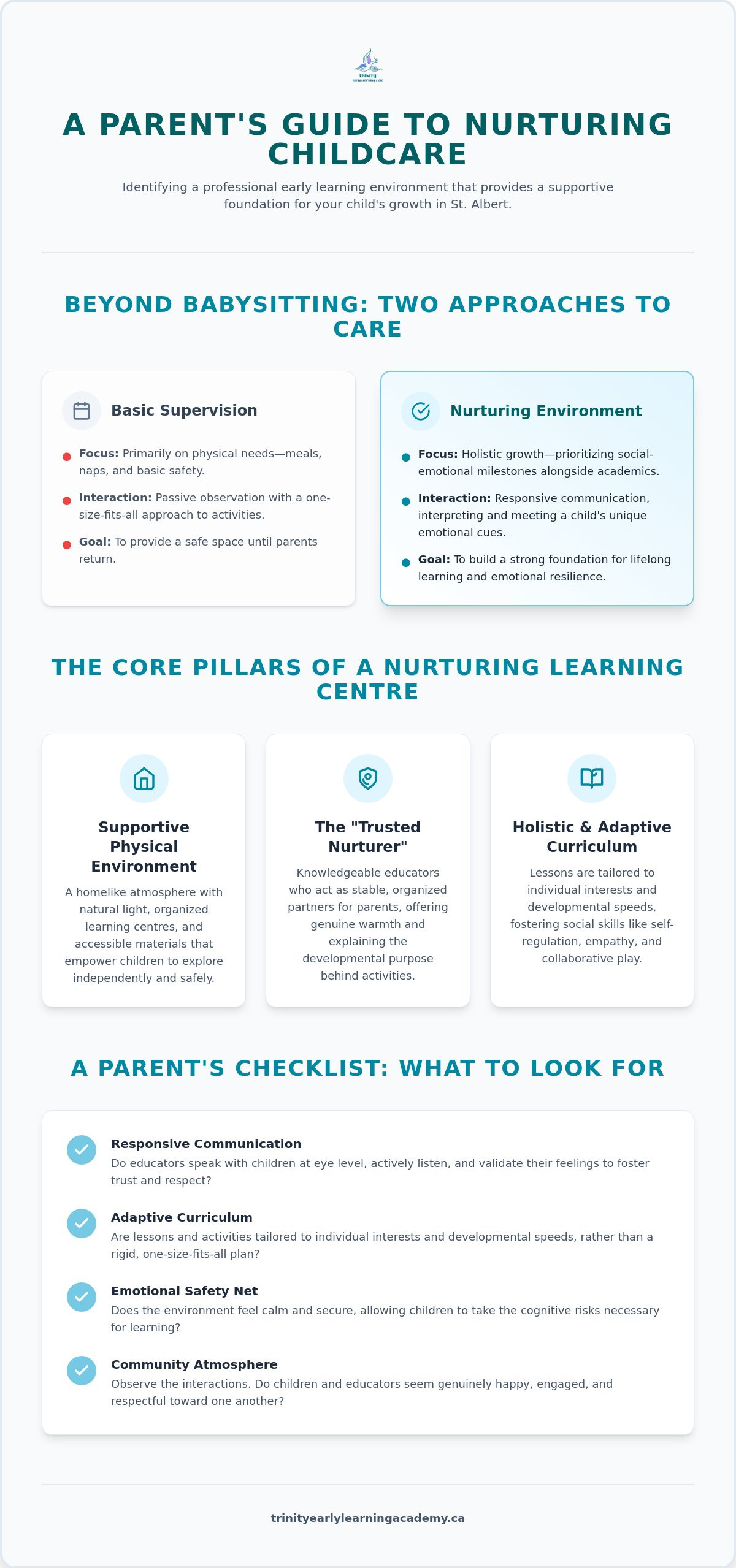
Basic care focuses primarily on physical needs like meals, naps, and physical safety. While these are essential, they represent only the starting point of a high-quality program. Holistic growth prioritizes social-emotional milestones, such as self-regulation, empathy, and collaborative play. Choosing a quality childcare St. Albert ensures your child enters an environment where their social skills are developed alongside their literacy and numeracy. Professional centres focus on several key areas:
- Responsive Communication: Educators speak with children at eye level to foster trust.
- Adaptive Curriculum: Lessons are tailored to individual interests and developmental speeds.
- Emotional Resilience: Children are taught how to identify and manage their feelings in a supportive space.
By moving beyond simple supervision, professional centres create a space where children don't just wait for their parents to return. They thrive, learn, and build a strong foundation for their future education.
The Core Pillars of a Nurturing Learning Centre
Establishing a foundation for a child's future requires more than a safe building; it demands a structured approach to care that prioritizes both emotional and physical development. Providing nurturing childcare in St. Albert involves several core pillars that work in harmony to create a stable environment. These pillars include the design of the physical space, the specific expertise of the educators, and the continuity of care as a child grows. When these elements align, children feel a sense of belonging that allows them to focus on exploration and learning.
A Supportive Physical Environment
The layout of a childcare centre significantly impacts a child's stress levels and ability to focus. A nurturing space utilizes natural light and organized learning centres to create a "homelike" atmosphere while strictly adhering to safety protocols. When materials are stored at an accessible height and the room is free of clutter, children feel empowered to engage in independent exploration. This intentional design serves as the backdrop for a safe daycare environment Alberta parents can trust. A well-ordered space reduces overstimulation, helping children remain calm and engaged throughout the day.
The Human Element: Professional Educators
Specialized training is what separates professional care from simple supervision. In Alberta, early childhood educators are certified at Level 1, 2, or 3, with each level bringing deeper knowledge of developmental psychology and curriculum design. These professionals use the "Flight" framework, Alberta's curriculum for early learning, to guide their interactions. Educators realize the potential in every child by documenting their interests and tailoring activities to meet their specific needs. This professional oversight is a key component of Alberta's childcare licensing standards, ensuring that staff-to-child ratios and certification levels are always maintained for optimal care.
Continuum of Care: From Daycare to Out of School Care
Stability is essential for a child's emotional health, especially during the transition to elementary school. Many families find immense value in centres that offer a continuum of care, allowing children to stay within the same community as they age. When a child moves from preschool into out of school care St. Albert, they benefit from established relationships with staff who already understand their personality and needs. This long-term connection fosters a deep sense of security for both the child and the parents. If you are looking for a partner in your child's journey, you might consider how Trinity Early Learning & OSC focuses on building these lasting community bonds.
Transparency and communication serve as the final pillar. A nurturing centre maintains an open dialogue with families, providing regular updates on a child's progress and daily experiences. This partnership ensures that the care provided at the centre remains a consistent extension of the child's life at home.
Why Licensing and Nurturing Go Hand-in-Hand in Alberta
Licensing is often misunderstood as a purely administrative hurdle. Some parents worry that a licensed facility might feel institutional or cold. It's actually the opposite. A license serves as the essential framework that allows for nurturing childcare in St. Albert by ensuring that the basic requirements for safety and staffing are always met. These regulations aren't just about paperwork; they create the stability needed for educators to focus on your child's emotional needs. When a centre is licensed, it means Alberta Health Services (AHS) and provincial licensing officers conduct regular inspections to verify that the environment is safe, sanitary, and properly managed. These standards ensure that every "Trusted Nurturer" in the building has passed a thorough background check and holds the necessary certifications to guide your child's development.
The Safety-Nurture Connection
A primary benefit of licensing is the enforcement of strict staff-to-child ratios. For example, a ratio of one educator to four infants ensures that every baby receives individual attention and prompt responses to their needs. This level of supervision is what makes nurturing learning environments possible. Without these mandatory ratios, educators can become overwhelmed, which reduces the quality of emotional support they can provide. When comparing a licensed vs unlicensed daycare Alberta parents should note that only licensed facilities are held accountable to these specific staffing and nutritional standards. These requirements contribute to a child's holistic health by guaranteeing balanced meals and safe, active outdoor play every day.
Accessing the Alberta Affordability Grant
The financial aspect of childcare is a significant concern for most modern families. In Alberta, the provincial government has implemented a flat monthly parent fee for licensed programs, which significantly reduces the cost of high-quality care. As of 2025, full-time care for children from infancy to kindergarten age in a licensed centre is capped at $326.25 per month. This affordability is made possible through grants paid directly to the providers. However, these savings are only available at licensed centres. This means that choosing a licensed path isn't just about safety; it's about making professional care accessible. Because of this, daycare enrollment St. Albert often prioritizes licensed facilities where families can save an average of $11,000 per year per child. This financial support allows parents to choose a centre based on the quality of its nurturing environment rather than just the lowest price point.
Ultimately, a license provides the authoritative clarity that families need to feel secure. It confirms that the centre isn't just a place of business, but a regulated community partner dedicated to the safety and joy of the children in its care. This structure allows the emotional warmth of the program to shine through without compromising on professional standards.
How to Recognize a Nurturing Environment: A Parent’s Checklist
Identifying nurturing childcare in St. Albert requires looking beyond the physical facility to observe the quality of human connection happening inside. When you enter a classroom, the first thing to notice is the physical positioning of the educators. Professional nurturers engage with children at eye level, often sitting on the floor or at low tables to create a sense of equality and safety. Listen for a calm, respectful tone of voice, even during busy transition times. The atmosphere should feel like a vibrant, happy community where children are active and engaged, rather than a chaotic space or one that is eerily quiet. A nurturing environment allows for the natural noise of play while maintaining a sense of organized calm.
Conflict resolution provides a clear window into a centre's philosophy. Ask the staff how they handle "big emotions" or peer-to-peer disagreements. A supportive centre treats these moments as opportunities for social-emotional growth rather than situations that require simple discipline. You should also review the daily rhythm to ensure there's a healthy balance. A professional program integrates structured early childhood education with plenty of time for free, imaginative play. Finally, consider how the centre handles parent engagement. You should feel confident that you'll receive regular, transparent updates regarding your child's emotional well-being and developmental milestones, not just a report on what they ate.
Questions to Ask During a Centre Tour
During your visit, use specific questions to reveal the staff's approach to care. These inquiries help you move past surface-level observations to understand the "Trusted Nurturer" persona of the team. Consider asking the following:
- "How do you support a child who is having a difficult morning or struggling with separation anxiety?"
- "Can you show me examples of child-led projects or artwork currently on display?"
- "What is your process for helping children navigate social challenges with their peers?"
- "How do educators document and share a child's unique developmental progress with parents?"
Look for evidence of the children's own creativity on the walls. Displayed artwork should look like it was created by the children themselves, showcasing their individual exploration rather than uniform, adult-led crafts.
Red Flags to Watch For
Certain signs may indicate an environment that lacks the necessary emotional support. High staff turnover is a major concern, as it prevents children from forming the stable, long-term bonds they need to feel secure. If educators seem disengaged or are primarily talking to each other rather than interacting with the children, the centre may be prioritizing supervision over nurturing. Additionally, a lack of transparency regarding licensing status or the application of provincial affordability grants is a serious warning sign. If you want to experience a community focused on these high standards, you can book a tour of our St. Albert childcare centre to see our philosophy in action.
Remember that silence in a daycare isn't always a positive indicator. While a calm room is good, an environment that is too quiet might suggest an overly restrictive atmosphere where children don't feel free to express their joy or curiosity. Trust your instincts as you assess the "vibe" of the community.
Trinity Early Learning & OSC: Your Partner in Nurturing Development
Trinity Early Learning & OSC stands as a dedicated partner for families seeking nurturing childcare in St. Albert. As a family-run and privately owned centre, we recognize that your child's early years represent the most significant period for emotional and cognitive development. We prioritize a community-focused atmosphere where every child is respected as a unique individual. Our philosophy blends the emotional warmth of a supportive home with the professional structure of a high-quality early learning environment. This approach ensures that children feel safe enough to explore, learn, and build meaningful connections with their peers and educators.
We understand the practical needs of modern families in our city. By acting as a stable and compassionate partner, we help bridge the gap between home and school life. Our team is committed to maintaining a transparent relationship with every parent, ensuring you remain informed and confident in your child's daily experiences. We don't just provide a space for your child to stay; we provide a community where they can truly belong.
Our Approach to Early Childhood Education
We believe that meeting licensed daycare St. Albert standards is only the baseline for excellence. Our preschool programs are intentionally designed to ensure kindergarten readiness by focusing on holistic growth. This means we balance academic foundations like early literacy and numeracy with essential social-emotional skills. Our staff members fully embrace the "Trusted Nurturer" role, acting as compassionate guides who observe and document each child's progress throughout the day. By responding to individual interests and developmental cues, we create a learning experience that is both engaging and developmentally appropriate for every age group.
Joining the Trinity Family in St. Albert
Navigating the administrative side of childcare can be complex. We act as a knowledgeable advocate by helping parents navigate the enrolment process and understand how to maximize the available Alberta affordability grants. These grants are a vital resource for making nurturing childcare in St. Albert accessible and affordable for local families. We strive to make the transition into our care as smooth as possible for both you and your child.
We invite you to tour our facility to experience our supportive environment firsthand. Seeing our educators in action and observing the happy, busy community we've built is the best way to determine if our centre is the right fit for your family. Trinity Early Learning & OSC remains committed to being a stable, compassionate partner for your child's journey, providing the professional foundation they need to thrive in their early years and beyond.
Building a Bright Future Together
Selecting the right path for your child's early years is a journey that requires both heart and professional assurance. You now understand that nurturing childcare in St. Albert is defined by the intentional balance of emotional warmth and rigorous early childhood education standards. By prioritizing licensed facilities, you ensure your child benefits from safe staffing ratios and the significant savings provided by federal-provincial affordability grants. These structural foundations allow educators to focus on what matters most: your child's unique development and emotional well-being.
Trinity Early Learning & OSC remains St. Albert's trusted choice for preschool and out of school care. As a centre licensed by the Province of Alberta, we are committed to providing a stable, compassionate environment where every child is treated as an individual. We participate in the federal-provincial affordability grants to ensure high-quality care is accessible to our community. We invite you to see our philosophy in action and meet our team of dedicated educators. Book a tour at Trinity Early Learning & OSC to experience our nurturing environment firsthand. We look forward to becoming a supportive partner in your child's growth and helping them build a strong foundation for the years ahead.
Frequently Asked Questions
What exactly makes a childcare centre 'nurturing'?
A nurturing centre is defined by responsive interactions where educators interpret and validate a child's unique emotional cues. It goes beyond basic supervision by creating a community where children feel a sense of belonging and security. This environment allows for the intentional practice of emotional and cognitive support, ensuring every child feels safe enough to explore their surroundings and build confidence.
Is a nurturing environment only important for infants and toddlers?
Nurturing is essential for all developmental stages, from infancy through the school-age years. While the type of care evolves, the need for emotional safety remains constant to support healthy brain development. For older children in out of school care, a nurturing tone helps them manage the social complexities of elementary school and provides a stable, compassionate space to unwind after a structured school day.
Can I find affordable nurturing childcare in St. Albert?
Yes, affordable nurturing childcare in St. Albert is accessible through the Alberta Child Care Affordability Grant. Licensed facilities participate in this federal-provincial program, which provides a flat monthly parent fee for families. As of 2025, full-time care for children from infancy to kindergarten age is capped at $326.25 per month, making high-quality, professional early learning much more attainable for local families.
How do licensed centres in Alberta ensure they stay nurturing?
Licensed centres maintain high standards through mandatory staff-to-child ratios and regular inspections by Alberta Health Services and provincial licensing officers. These regulations ensure that educators have the proper background checks and certifications, such as Level 1, 2, or 3 Early Childhood Educator status. This professional framework provides the stability and individual attention necessary for a truly supportive and safe environment for every child.
What is the difference between a preschool program and a nurturing daycare?
A preschool program typically focuses on kindergarten readiness through a structured curriculum, while a daycare provides comprehensive care throughout the work day. However, a high-quality centre integrates both by providing a nurturing daycare environment that includes a formal preschool curriculum. This combination ensures that children are emotionally supported while they develop the literacy, numeracy, and social-emotional skills needed for future academic success.
How do I apply for the Alberta childcare grant at Trinity Early Learning & OSC?
You don't need to submit a separate application for the Affordability Grant; Trinity Early Learning & OSC handles this process directly with the government. The grant is paid to the centre, and the savings are passed on to you through reduced monthly fees. Our team acts as a knowledgeable advocate to help you understand the billing process and ensure you receive the full benefit of available provincial financial supports.
What should I look for during a daycare tour in St. Albert?
During a tour, observe whether educators interact with children at eye level and use a calm, respectful tone. Look for evidence of child-led projects and original artwork on display, which indicates an environment that celebrates individual creativity. You should also assess whether the atmosphere feels like a busy, happy community where children are engaged and staff are actively participating in their play and learning.
Does 'play-based learning' really prepare my child for school?
Play-based learning is a highly effective tool for school readiness because it builds critical problem-solving and social skills. Through play, children learn how to collaborate with peers, follow complex instructions, and manage their emotions. These social-emotional milestones are just as important for kindergarten success as academic foundations, as they provide the resilience and focus a child needs to thrive in a formal classroom setting.


