
What if the most valuable skills your child gains in preschool have nothing to do with the alphabet? While many St. Albert parents feel a quiet pressure to ensure their little ones are "kindergarten ready" by drilling letters and numbers, the true power of early education lies in the non-academic benefits of preschool. It's common to worry about academic burnout or feel a sense of guilt when leaving your child at a centre, but these early years are actually about building a sturdy internal engine for the future.
You want to feel confident that your childcare choice is setting a strong foundation. This article explains how quality preschool programs in Alberta use intentional play to build the social, emotional, and physical skills your child needs for a lifetime of success. We'll look at how these environments foster resilience, teach conflict resolution, and support the motor development that makes all future learning possible. By understanding how play-based learning works, you can gain peace of mind knowing your child is exactly where they need to be.
Key Takeaways
- Learn why focusing on the whole child creates a stronger foundation for future learning than early academic drilling.
- Discover how preschool environments help children develop the social intelligence and emotional resilience needed to navigate peer relationships.
- Understand the non-academic benefits of preschool, such as building executive function skills that act as the brain's internal air traffic control system.
- See how structured play in Alberta programs teaches children essential concepts like cause and effect while improving physical coordination.
- Identify what to look for in a St. Albert centre, including the importance of licensing and a family-run atmosphere for emotional security.
Understanding Holistic Growth: Why Preschool Is More Than Academics
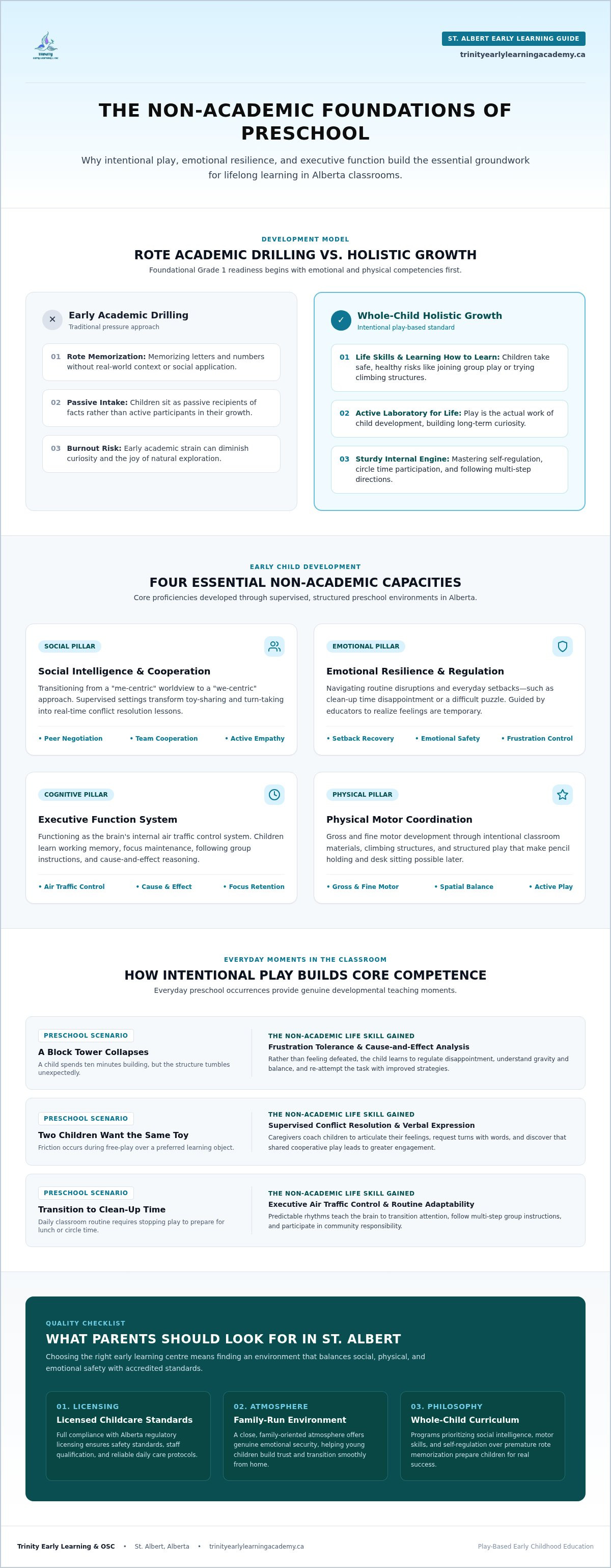
Holistic growth is the intentional balance of a child's social, physical, and emotional health. It recognizes that a child's development isn't a series of separate boxes to check, but an integrated system where each part supports the others. In St. Albert, quality early learning programs move away from the rigid academic push that many parents worry will lead to early burnout. Instead, these programs focus on the whole child. For a three or four-year-old, play isn't just a break from learning; play is the actual work of development.
The non-academic benefits of preschool become clear when we look at how children interact with their environment. While memorizing the alphabet is a fine skill, it doesn't teach a child how to share, how to wait their turn, or how to handle the frustration of a collapsing block tower. These emotional and social foundations are what truly prepare a child for the years ahead. By prioritizing this balance, educators create a stable environment where children feel secure enough to explore the world around them.
The Shift from Rote Learning to Life Skills
Modern early childhood education in St. Albert prioritizes learning how to learn over simple rote memorization. When children are in a nurturing environment, they feel safe enough to take healthy risks. This might mean trying a new climbing structure or joining a group of peers in a pretend-play scenario. These moments build confidence and problem-solving abilities that facts alone cannot provide. By focusing on these life skills, educators ensure that children are active participants in their own growth rather than passive recipients of information. This approach transforms the classroom into a laboratory for life.
Building the Foundation for Future Success
A child's success in Grade 1 often depends more on their social readiness than their ability to read before they arrive. Research into early childhood education shows that foundational development involves mastering social and physical competencies first. If a child cannot sit in a circle, follow instructions, or manage their emotions, they will struggle to focus on literacy or math later. The non-academic benefits of preschool include fostering a natural curiosity that drives long-term educational engagement. St. Albert parents increasingly prioritize these social foundations because they understand that a happy, socially adjusted child is a child who is ready to learn. When we protect the joy of discovery through play, we build a sturdy base for everything that follows.
Developing Social Intelligence and Emotional Resilience
Social intelligence is the ability to navigate peer relationships with confidence and empathy. In a preschool setting, children step out of their family bubble and into a community of peers. This environment provides a supervised space to practice conflict resolution. When two children want the same toy, it isn't just a disruption. It's a vital teaching moment. One of the most significant non-academic benefits of preschool is that children learn to recognize and respect the feelings of others. These early interactions are the start of lifelong empathy.
Emotional resilience grows through the predictable rhythms of daily routines and the minor setbacks of a school day. A child might feel disappointed when it's time to clean up or frustrated when a puzzle is difficult. Professional caregivers guide them through these moments, helping them understand that feelings are temporary. This steady support ensures that children don't just experience emotions; they learn to manage them. These non-academic benefits of preschool prepare children for the social complexities of later school years. If you are looking for a supportive environment for your child, consider the licensed daycare services offered in our community.
Learning the Art of Cooperation
The transition from a "me-centric" worldview to a "we-centric" one is a major milestone in early development. Collaborative play teaches children the mechanics of sharing and turn-taking. These aren't just polite habits. They are the building blocks of team cooperation. Educators play a quiet but active role in this process. They watch for social friction and step in to help children find the right words to express their needs. This guidance helps children realize that working together often leads to more fun than playing alone.
Managing Big Emotions in a Safe Space
Young children often experience intense feelings that they don't yet have the words to describe. In a quality preschool, professional caregivers teach specific self-regulation techniques. These lessons help children build executive function and self-regulation skills, which are essential for managing behaviour and staying focused. When a child feels emotionally safe, they are more willing to try independent problem-solving. They learn that they can handle challenges on their own, which builds deep-seated confidence. This emotional safety is a prerequisite for future academic learning, as a stressed brain cannot easily absorb new information.
Building Executive Function and Physical Coordination Skills
Preschool is often the first environment where a child's brain begins to manage complex tasks independently. This mental management is known as executive function. It acts as the "air traffic control" system of the brain, helping children filter distractions, prioritize tasks, and set goals. One of the most practical non-academic benefits of preschool is the way it helps children organize their thoughts and actions through predictable daily routines. When a child follows a schedule, they are practicing the mental discipline required for all future learning.
Physical activity is also deeply linked to this cognitive development. Research shows that movement isn't just about burning energy; it's about building the neural pathways that support focus and memory. By integrating physical play with structured tasks, quality programs help children develop executive function and self-regulation skills. These capacities are essential for managing behaviour and staying focused on a task until it is finished. In St. Albert, educators use these activities to ensure children are physically and mentally prepared for the transition to primary school.
Executive Function: The Brain’s Management System
Developing executive function involves mastering three key areas: working memory, mental flexibility, and self-control. In a preschool setting, this looks like a child following multi-step directions, such as putting away their coat before choosing a station. These small acts of organization build the mental stamina needed to stay on task. These non-academic benefits of preschool often translate to easier mornings for families at home. As children become more capable of managing their own belongings and following a routine, they gain a sense of independence that reduces daily friction for parents.
Fine and Gross Motor Development
Physical coordination is a primary goal of early education that goes far beyond simple playground fun. Fine and gross motor skills are developed through intentional activities designed to build strength and balance. These include:
- Fine Motor Skills: Using play-dough, safety scissors, and craft materials to build hand strength. This strength is a prerequisite for holding a pencil and writing in the years to come.
- Gross Motor Skills: Active outdoor play that encourages climbing, running, and jumping. These activities improve balance and spatial awareness.
When a child gains physical confidence, it often leads to increased social confidence. A child who feels steady on their feet and capable in their movements is more likely to join in group games and explore new environments. This physical mastery provides a sense of security that allows children to focus their energy on social interactions and creative play. To see how specialized after-school programs can further support this development through structured movement, you can discover Bushi Ban Child Care and their unique approach to youth fitness.
Alberta’s early learning framework recognizes that children learn best when they're actively engaged with their environment. Unlike a traditional classroom where kids might sit at desks, a play-based curriculum encourages them to explore, experiment, and ask questions. This approach is the most effective way to teach preschoolers because it aligns with their natural curiosity. One of the greatest non-academic benefits of preschool is that it teaches children about cause and effect in a tangible way. Whether they're seeing how high they can stack blocks before they fall or what happens when blue and yellow paint mix, they're learning logical concepts through direct experience.
Imagination also plays a critical role in developing cognitive flexibility. When children engage in pretend play, they practice shifting their perspective and adapting to new rules or roles. This mental agility is a skill they'll use for the rest of their lives, from solving social problems to tackling complex tasks later on. By protecting the space for play, educators ensure that children develop a love for discovery that stays with them throughout their education. These non-academic benefits of preschool ensure that your child is not just memorizing facts, but learning how to think critically about the world around them.
The Difference Between Play and "Just Playing"
Beyond the preschool environment, many parents look for specialized programs to further nurture their child's talents. Even if you are not local to their Melbourne studio, you can explore Music Tuition Fees at Rising Tones Music to see how professional music schools structure their curriculum for early learners.
In a licensed centre, play is never accidental. Every toy, material, and activity is chosen with a specific developmental goal in mind. This is what distinguishes "just playing" from a professional curriculum. Educators observe how children interact with their surroundings and then extend that play to introduce more complex ideas. Play-based learning is intentional discovery where the child's interests lead the way. This method ensures that children stay engaged because the learning feels relevant to their own small worlds. It transforms a simple sandbox into a lesson on volume and a dress-up corner into a study of social roles.
Supporting Play-Based Learning at Home
St. Albert parents can easily encourage these same skills by prioritizing tactile experiences over screen time. Simple activities like helping with baking, playing in the dirt, or building with cardboard boxes provide rich sensory input that digital apps cannot replicate. These moments allow children to practice independent problem-solving without the pressure of a "right" or "wrong" answer. When your child comes home, try changing how you ask about their day. Instead of asking "what did you learn?", ask "what did you discover today?" or "who did you help?". This shifts the focus from academic output to the value of their social and physical experiences. If you want to see this philosophy in action, explore our quality childcare options in St. Albert.
Finding a Nurturing Learning Environment in St. Albert
Choosing the right centre is a significant decision that impacts your child's daily happiness and long-term growth. Licensing is the first factor to consider. In Alberta, a licensed status ensures that a facility meets strict provincial standards for safety, staffing, and program quality. These regulations provide the stable environment necessary for children to experience the non-academic benefits of preschool. When a child feels physically and emotionally secure, they are more willing to engage in the social exploration and physical play that builds a strong foundation for the future.
Family-run centres often offer an added layer of emotional security. These environments typically feel like an extension of the home, fostering a community-focused atmosphere where every child is known by name. This sense of belonging is a vital part of early development. Additionally, the Alberta Affordability Grant remains a key support for St. Albert families in 2026. This grant makes quality childcare more accessible by significantly reducing out-of-pocket costs. We handle the administrative details of these grants to ensure parents can focus on their child's milestones rather than paperwork.
What to Look for During a Centre Tour
When you visit a local facility, pay close attention to the rhythm of the room. Observe the interactions between educators and children. You should see warmth, patience, and a high level of respect for each child's individual pace. A quality environment will have varied play zones that encourage different skills, from quiet reading corners to active building areas. These spaces are designed to support the non-academic benefits of preschool by giving children choices in their learning. For a more detailed guide on what to verify, refer to our Daycare Safety Checklist St. Albert.
Joining the Trinity Community
Our centre is dedicated to nurturing the whole child through a balance of play and professional care. We understand the practical needs of modern families, which is why we offer a seamless transition from preschool to out of school care as your child grows. Our team acts as a knowledgeable advocate for your family, providing guidance on everything from developmental stages to the grant application process. We invite you to explore our Preschool Programs in St. Albert to see how we create a supportive atmosphere for every child in our care.
Setting Your Child Up for a Lifetime of Success
Choosing a preschool is about more than just finding a place for your child to learn their letters. It's about investing in the social, emotional, and physical foundations that sustain them throughout their lives. By focusing on the non-academic benefits of preschool, you ensure your child develops the resilience and cooperation skills needed for future success. Quality programs prioritize this holistic growth through intentional, play-based discovery.
As a family-run and community-focused centre in St. Albert, we are dedicated to providing a nurturing environment where your child can thrive. Our facility is licensed by the Government of Alberta, ensuring high standards of safety and care. We also help families navigate the Alberta affordability grant options to ensure quality early education remains accessible. This support allows you to focus on your child's joy and development rather than administrative hurdles.
Ready to see how our program supports your child's unique journey? Book a tour at Trinity Early Learning & OSC to see our nurturing environment in action. We look forward to welcoming your family into our community and helping your child build a bright future.
Frequently Asked Questions
What are the main non-academic benefits of preschool?
The main non-academic benefits of preschool include the development of social intelligence, emotional resilience, and executive function. These skills act as the foundation for all future learning by teaching children how to manage their emotions and interact with peers. In a licensed St. Albert centre, children also improve their physical coordination through structured play. These competencies ensure that a child is not just academically prepared, but socially and emotionally ready for the complexities of a primary school environment.
Is preschool necessary if my child is already social?
Even if a child is naturally social, preschool offers a unique environment to practice those skills with peers under professional guidance. It introduces children to social dynamics outside their family circle, requiring them to navigate conflict resolution and collaborative play. This setting helps them transition from a home-based focus to a community-focused mindset. Learning to share and take turns in a group of ten or twelve children provides essential practice that one-on-one playdates cannot always replicate.
How does preschool help with kindergarten readiness?
Preschool supports kindergarten readiness by building the internal air traffic control system of the brain. This includes following multi-step directions, staying on task, and adjusting to a predictable daily routine. While many focus on literacy, teachers often find that social readiness is a better predictor of early success. A child who can regulate their behaviour and listen to instructions is better equipped to absorb academic information once they reach their first elementary classroom in St. Albert.
What is play-based learning and why is it used in Alberta?
Play-based learning is an intentional approach where educators use a child's natural curiosity to teach complex concepts. In Alberta, this framework is used because it respects the developmental stage of young children. Instead of rote memorization, kids learn through discovery and experimentation. This method builds cognitive flexibility and problem-solving skills by allowing children to explore cause and effect. It transforms simple activities like building with blocks into valuable lessons about physics, volume, and cooperation.
Can preschool help with my child’s behaviour at home?
Many parents find that preschool positively impacts behaviour at home by fostering a sense of independence. When children learn to manage their own belongings and follow school routines, they often bring that confidence back to their families. The self-regulation techniques taught by professional caregivers help children understand their emotions better, which can lead to fewer tantrums. As they practice patience and turn-taking at school, these non-academic benefits of preschool often become a natural part of their daily interactions at home.
How do I know if a preschool program is high quality?
A high-quality program is defined by its licensing status and the warmth of its teacher-child interactions. In St. Albert, you should look for a centre that is licensed by the Government of Alberta and maintains a community-focused atmosphere. Observe whether the environment has clearly defined play zones that encourage different types of development. A quality facility will prioritize emotional security and holistic growth, ensuring that children feel safe enough to take healthy risks and explore their surroundings.
Does the Alberta Affordability Grant apply to preschool programs?
The Alberta Affordability Grant does apply to licensed preschool programs, making quality childcare much more accessible for local families. This grant is provided by the provincial government to reduce the monthly fees parents pay for their children's care. At Trinity Early Learning & OSC, we use these grant programs to support our community and ensure that every child can access a nurturing learning environment. It's a practical system designed to help families manage the costs of early education.


