

What if the very mud and cold we often avoid are actually the best tools for your child's brain development? Many St. Albert parents worry about the risks of outdoor play, especially when the temperature drops or a child climbs a bit too high on a log. Research shows that the outdoor play benefits for early childhood go far beyond just burning off energy. While it is natural to want to keep children warm and safe indoors, the natural world offers a type of learning that a structured gym simply cannot match.
You want your child to grow up healthy, confident, and resilient. We understand the balance between encouraging exploration and ensuring safety in our local climate. This guide will explain how nature-based play builds physical strength, cognitive focus, and social resilience in young children. You will learn about the specific developmental gains of being outside and gain clarity on what to look for when choosing a daycare with a high-quality outdoor space. By the end, you will feel confident that these outdoor experiences are a safe and vital part of your child's growth.
Key Takeaways
- Learn how regular time in nature improves gross motor skills and helps children achieve better sleep patterns through physical activity.
- Understand the outdoor play benefits for early childhood that support sensory development and build cognitive focus.
- Discover how unstructured play helps children learn to cooperate, negotiate, and resolve conflicts with their peers.
- Find out why managed "beneficial risk" is a safe way for children to build physical competence and body awareness.
- Gain clear criteria for evaluating the quality and safety of outdoor spaces in St. Albert childcare centres.
The Role of Nature in Early Childhood Development
Outdoor play is frequently misunderstood as a simple break from the "real" work of learning. In reality, the natural world acts as a sophisticated developmental laboratory. For children in their earliest years, every interaction with nature provides a foundation for future academic and personal success. When a child steps outside, they aren't just leaving the classroom; they are entering a space where the outdoor play benefits for early childhood can be fully realised through exploration and discovery.
Educators often describe the environment as the "third teacher" because of its power to shape a child's focus. Indoor classrooms are carefully controlled and predictable. While this provides a sense of security, it cannot match the sensory stimulation found in the open air. The smell of damp earth, the sound of wind through leaves, and the shifting patterns of sunlight engage a child's senses in ways that artificial environments cannot. This constant, gentle stimulation helps children develop the ability to filter information and maintain cognitive focus.
Moving Beyond Traditional Playgrounds
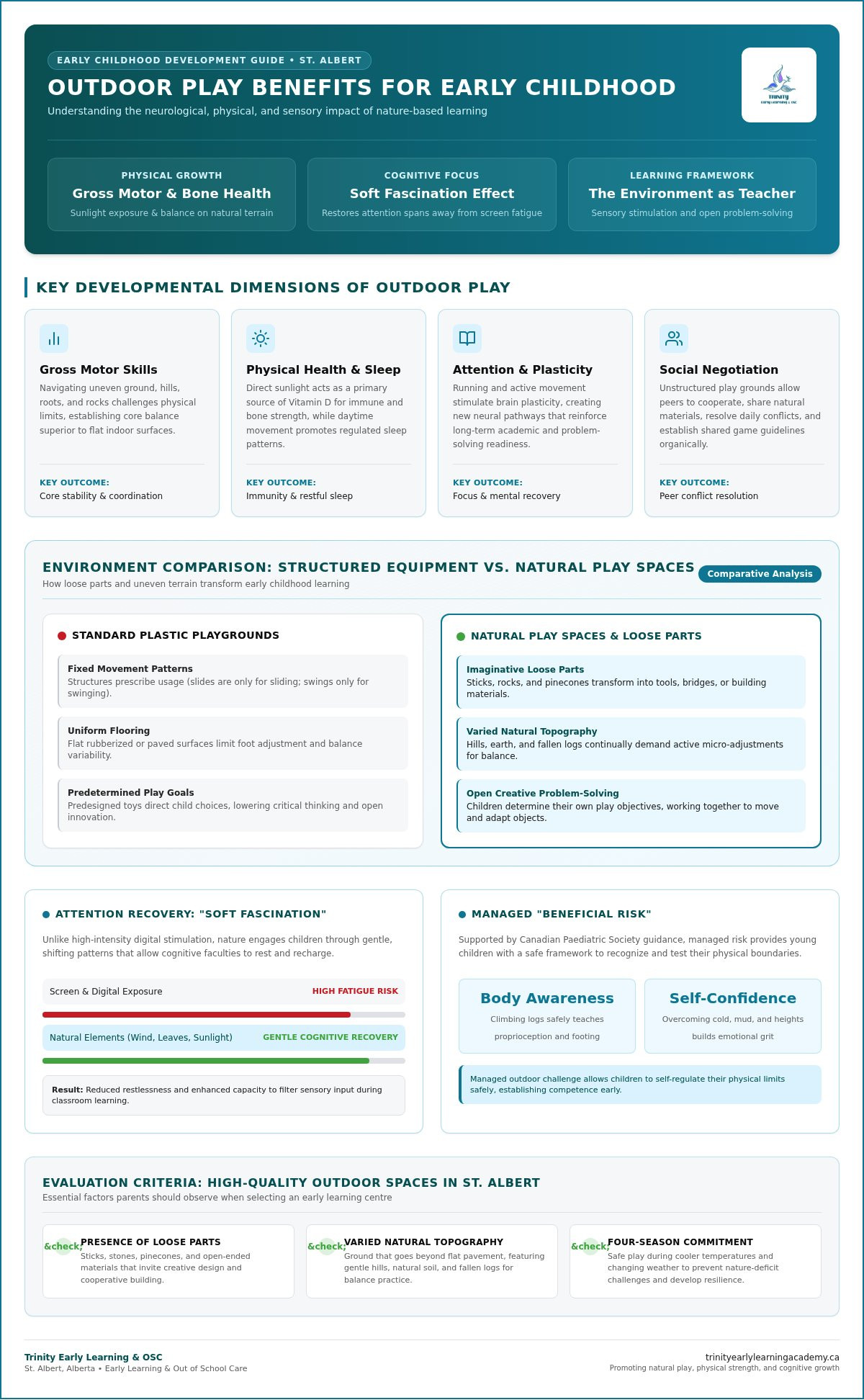
Standard playgrounds often feature fixed plastic equipment that dictates exactly how a child should move. A slide is for sliding, and a swing is for swinging. Natural play spaces offer a different approach. By including "loose parts" like sticks, stones, and pinecones, we invite children to use their imagination. A simple branch can become a tool, a building material, or a bridge. This type of play encourages creative problem-solving and critical thinking. Additionally, the uneven terrain of a natural space challenges a child's physical limits. Negotiating hills, roots, and rocks builds better balance and coordination than walking on flat, rubberized flooring.
Why Modern Children Need More Outdoor Time
The rise of digital entertainment has led to a significant shift toward sedentary, indoor activities. This lack of connection to the outside world is linked to nature-deficit disorder, a concept that highlights how reduced outdoor time contributes to emotional and behavioral challenges. Children need the outdoors to reduce stress and build resilience. Access to green space is a vital part of early childhood education St. Albert parents should look for when choosing a care provider. Prioritising time in nature ensures that children develop a healthy relationship with their environment while gaining the many outdoor play benefits for early childhood that support long-term well-being.
Physical and Cognitive Growth Through Outdoor Exploration
Physical activity serves as a primary engine for brain development in the early years. When children run, jump, and climb, their brains experience increased plasticity, which is the ability to form new neural connections. These outdoor play benefits for early childhood extend far beyond simple physical fitness. They create a neurological foundation that supports complex learning later in life. In a natural setting, the brain must constantly process changing sensory data, which keeps the mind active and engaged.
Building Motor Skills and Physical Health
Navigating the natural world requires a higher level of physical engagement than walking on a flat, indoor floor. When children balance on a fallen log or step over stones, they build core strength and fine-tune their coordination. This constant adjustment to uneven terrain is vital for developing gross motor skills. Exposure to fresh air and natural sunlight also plays a critical role in health. Sunlight is a primary source of Vitamin D, which is essential for bone health and immune function. According to the Canadian Paediatric Society's guidance on outdoor play, these experiences help children learn to manage their own physical limits safely. Strong physical health is a key component of the goals found in preschool programs St. Albert families trust, as a healthy body allows a child to focus more effectively on their studies.
Enhancing Focus and Cognitive Function
Nature provides a unique environment for restoring mental energy through a concept known as "soft fascination." Unlike the high-intensity stimulation of screens, the gentle movements of clouds or trees allow the brain to rest and recover. This restoration leads to improved attention spans and a reduction in symptoms of restlessness. Cognitive growth also occurs when children engage in open-ended problem-solving, such as figuring out how to prop up a heavy branch or channel water through a mud trench. These activities strengthen executive function and memory, which are essential for academic success. By mastering these challenges outdoors, children develop the mental stamina required for the classroom environment. Families seeking licensed daycare services that value this holistic growth will find that regular outdoor exploration is a cornerstone of our daily routine.
Social and Emotional Resilience in the Great Outdoors
Nature provides a vast, open-ended space where social hierarchies often dissolve. Unlike the structured environment of a classroom, the outdoors requires children to communicate more clearly to achieve shared goals. Whether they are building a fort or creating a pretend shop in the mud, children must negotiate roles and share resources. These outdoor play benefits for early childhood foster a sense of community and mutual respect. Mastering a difficult climb or successfully building a structure also builds profound self-confidence. These small victories in the woods or garden translate to a "can-do" attitude that children carry back into their indoor learning environments. For families seeking structured ways to build this same confidence, foundational programs like horsemanship lessons Texas provide a unique opportunity for children to learn respect and responsibility through ground-up equine education.
Communication patterns change significantly when children are outside. Without the physical constraints of four walls, children tend to use louder, more assertive language and more complex body cues. Group games in the fresh air teach children how to take turns leading and following directions without the constant intervention of an adult. This type of social growth is a primary focus within a licensed daycare St. Albert families choose for their children's development. By interacting in less structured ways, children learn the nuances of peer collaboration that are vital for future social success. They learn to listen to others' ideas and compromise to keep the game going.
Emotional Regulation and Stress Reduction
The natural world has a measurable calming effect on the developing nervous system. Soft greens, blues, and browns, combined with the rhythmic sounds of nature, help lower stress hormones and reduce anxiety. For children who struggle with big emotions, the outdoors offers a safe outlet for expression. Engaging in "heavy work," such as moving large branches or carrying buckets of water, helps children organize their sensory input and find a sense of internal calm. Research into the essential developmental benefits of outdoor play shows that these activities are not just leisure; they are critical for emotional health. This connection to the earth also builds early empathy. As children observe a beetle or help water a plant, they realize their own power to nurture and protect the environment around them. This sense of stewardship is a vital emotional milestone that begins with simple, daily outdoor exploration. For parents looking to extend these values into their home life, Homesteading to Riches provides a community for families to explore self-sufficiency and deeper connections with the natural world.
It is natural for parents to feel a sense of hesitation when they see their child attempting a challenging climb or playing in the mud on a chilly morning. These concerns often stem from a desire to protect children from physical harm or illness. However, distinguishing between a dangerous hazard and a beneficial risk is a key part of understanding the outdoor play benefits for early childhood. While a hazard is something a child cannot see or evaluate, such as a sharp object or a broken fence, a beneficial risk is a challenge that a child can see and decide to tackle. These experiences are vital for building physical competence and self-reliance.
Managing Risk and Safety in Play
When children engage in managed risky play, such as balancing on a fallen log or navigating a steep hill, they develop a better sense of their own physical limits. Research suggests that daily exposure to these challenges can actually reduce the risk of future injuries by 23 per cent. This occurs because children build better depth perception, motor planning, and body awareness. Our educators provide a safe daycare environment Alberta parents can trust by maintaining a balance between freedom and supervision. We use a framework of dynamic risk assessment, where teachers monitor play closely to ensure challenges remain age-appropriate. This approach allows children to build confidence without being exposed to actual danger. You can learn more about our standards by reviewing our daycare safety checklist St. Albert families use to evaluate quality care.
Adapting to Alberta’s Changing Seasons
St. Albert weather can be unpredictable, but cold temperatures do not have to mean the end of outdoor exploration. We follow a "no bad weather, only bad clothing" philosophy. Dressing children in layers, including moisture-wicking base layers and insulated, waterproof outer shells, ensures they stay warm and dry. Playing in the snow and mud provides unique sensory experiences that indoor play cannot replicate. Whether it is feeling the crunch of frost or the weight of wet snow, these interactions are essential for sensory development. Safety remains our priority, and we monitor local conditions carefully. We typically follow provincial guidelines that recommend keeping children indoors when temperatures or wind chill reach -20°C to -21°C. By respecting these limits and preparing with the right gear, we ensure that children continue to grow and learn outside throughout the year. If you are looking for a program that values year-round nature immersion, we invite you to contact our licensed daycare services to learn more about our daily schedule.
How Our St. Albert Learning Centre Prioritizes Outdoor Time
We believe every child deserves a daily connection with nature. Our schedule is built to ensure consistent access to the fresh air of St. Albert, regardless of the season. By treating the outdoors as a core part of our learning environment, we help children realize the full range of outdoor play benefits for early childhood. This approach ensures that physical activity and cognitive exploration happen together rather than in isolation. Our commitment to a nurturing and stimulating environment means that we view the natural world as an essential partner in your child's development.
Integrating Nature into Our Preschool Curriculum
Learning does not stop at the doorway. We use natural materials to teach fundamental concepts in math and science. For example, children practice counting and sorting by using pinecones, stones, or twigs they find on the ground. Science lessons come alive as we observe local bird species or track the changing colours of the leaves. Our educators act as guides during these sessions. They facilitate discovery by asking open-ended questions that encourage children to think critically about the world around them. We also bring literacy and art outdoors by setting up reading corners under the trees or using natural pigments for creative painting projects. This integration ensures that academic goals are met while children enjoy the freedom of the open air.
Creating a Safe and Engaging Outdoor Environment
A high-quality outdoor space must be both stimulating and secure. We maintain a high standard of cleanliness and perform regular safety checks on all equipment and natural features to ensure they meet Alberta's licensing standards. Our play area is organized into specific zones to support different types of engagement. This allows for high-energy active play in one area while providing quiet, shaded spots for children who prefer to observe or engage in solitary play. This same commitment to quality extends to our out of school care St. Albert programs. Older children also benefit from structured outdoor challenges that build leadership and team-building skills after their school day is complete.
We invite you to see our commitment to nature-based learning in person. Seeing how children interact with our outdoor spaces is the best way to understand the value of our approach. We would be happy to show you how we balance safety, education, and joy in our daily routines. Please reach out to our team to schedule a tour of our facility and see our learning environment firsthand.
Building a Brighter Future Through Nature
Choosing the right environment for your child is one of the most important decisions you'll make. As we've explored, the outdoor play benefits for early childhood extend into every area of growth, from physical coordination to emotional resilience. By embracing nature as a teacher, children develop the confidence to master new challenges and the focus required for future academic success. We believe that every child deserves a safe, supportive space to explore the world around them.
At Trinity Early Learning & OSC, we provide licensed and regulated childcare services that follow strict Alberta standards. Our experienced educators prioritize safety while delivering a dedicated preschool curriculum that values holistic development. We are committed to providing a stable and organized environment where your child can thrive in both indoor and outdoor settings. Book a tour of Trinity Early Learning & OSC today to see our nurturing play spaces. We look forward to partnering with your family to support your child's journey toward a healthy and joyful future.
Frequently Asked Questions
Is outdoor play safe for toddlers during the winter in St. Albert?
Outdoor play is safe and healthy for toddlers in St. Albert when temperatures remain above -20°C. We monitor the wind chill carefully to ensure children stay warm and protected. Proper thermal layering is essential to prevent cold-related illness. When children are dressed in moisture-wicking fabrics and waterproof outer layers, they can enjoy the snow safely. Our educators perform constant checks to ensure every child remains comfortable while exploring the winter landscape.
How much time should a child spend outdoors each day for maximum benefit?
The Canadian 24-Hour Movement Guidelines recommend that toddlers and preschoolers accumulate at least 180 minutes of physical activity daily. For children aged three to four, at least 60 minutes of this should be energetic play. These targets help children realize the full outdoor play benefits for early childhood, including better sleep and stronger immune systems. We ensure our daily schedule provides ample time for both structured and unstructured exploration in the fresh air.
What should I look for in a daycare's outdoor play area?
Parents should look for a space that meets the Alberta licensing requirement of 4.5 square metres per child. A high-quality area should offer more than just plastic structures. Look for natural elements like logs, stones, and hills that challenge a child's balance. The space must be fully enclosed and well-maintained. A variety of textures and "loose parts" like sticks and pails indicate a commitment to stimulating, open-ended learning.
How do teachers supervise children during unstructured outdoor play?
Our educators use dynamic risk assessment to supervise children without interrupting their discovery. We maintain a high teacher-to-child ratio to ensure every interaction is monitored for safety. Instead of stopping all risky play, we observe how children navigate challenges like climbing or balancing. This allows us to intervene only when a real hazard is present. This method helps children build physical competence and body awareness while staying within a secure environment.
What if my child does not like playing outside or getting dirty?
It is common for some children to be hesitant about mud or cold weather initially. We encourage participation through gentle, interest-based activities like bird watching or counting natural objects. Our educators help children feel secure by providing clear boundaries and supportive guidance. Over time, the calming effect of nature usually helps children overcome their sensory aversions. We focus on the joy of discovery rather than the mess, helping every child feel comfortable outdoors.
Does outdoor play really help with kindergarten readiness?
Yes, outdoor exploration is a vital part of kindergarten readiness. It builds the executive function and self-regulation skills children need to thrive in a school setting. Through peer negotiation and problem-solving outside, children learn how to cooperate and follow complex directions. The physical strength gained from navigating uneven terrain also helps with the fine motor skills required for writing. These experiences create a well-rounded foundation for academic and social success in later years.
How do you handle outdoor play during extreme weather conditions?
We follow strict provincial safety thresholds for all outdoor activities. If the ambient temperature or wind chill reaches -20°C, we transition our programs to indoor active play spaces. We also monitor for severe weather alerts, high winds, or poor air quality. When conditions are not suitable for being outside, we use our indoor facilities to provide movement-based learning that mimics the physical challenges of the outdoors. This ensures child safety while maintaining a consistent daily rhythm.
What are the best types of clothing for outdoor play in Alberta?
Success in the Alberta climate requires a three-layer system. Children should wear a moisture-wicking base layer, an insulating middle layer like fleece, and a waterproof, windproof outer shell. Insulated boots, waterproof mittens, and hats that cover the ears are also mandatory for winter play. During the mud season, waterproof mudsuits are excellent for keeping children dry. Providing the right gear ensures that children can focus on their play rather than feeling cold or damp.


